Arpita Shah Photographs the Gaps in a Family Archive
Arpita Shah’s photographic family archaeology treats migration as a history carried through bodies, keepsakes, silences, and incomplete memories.
By Weston Deboer
October 28, 2026 · 3 min read
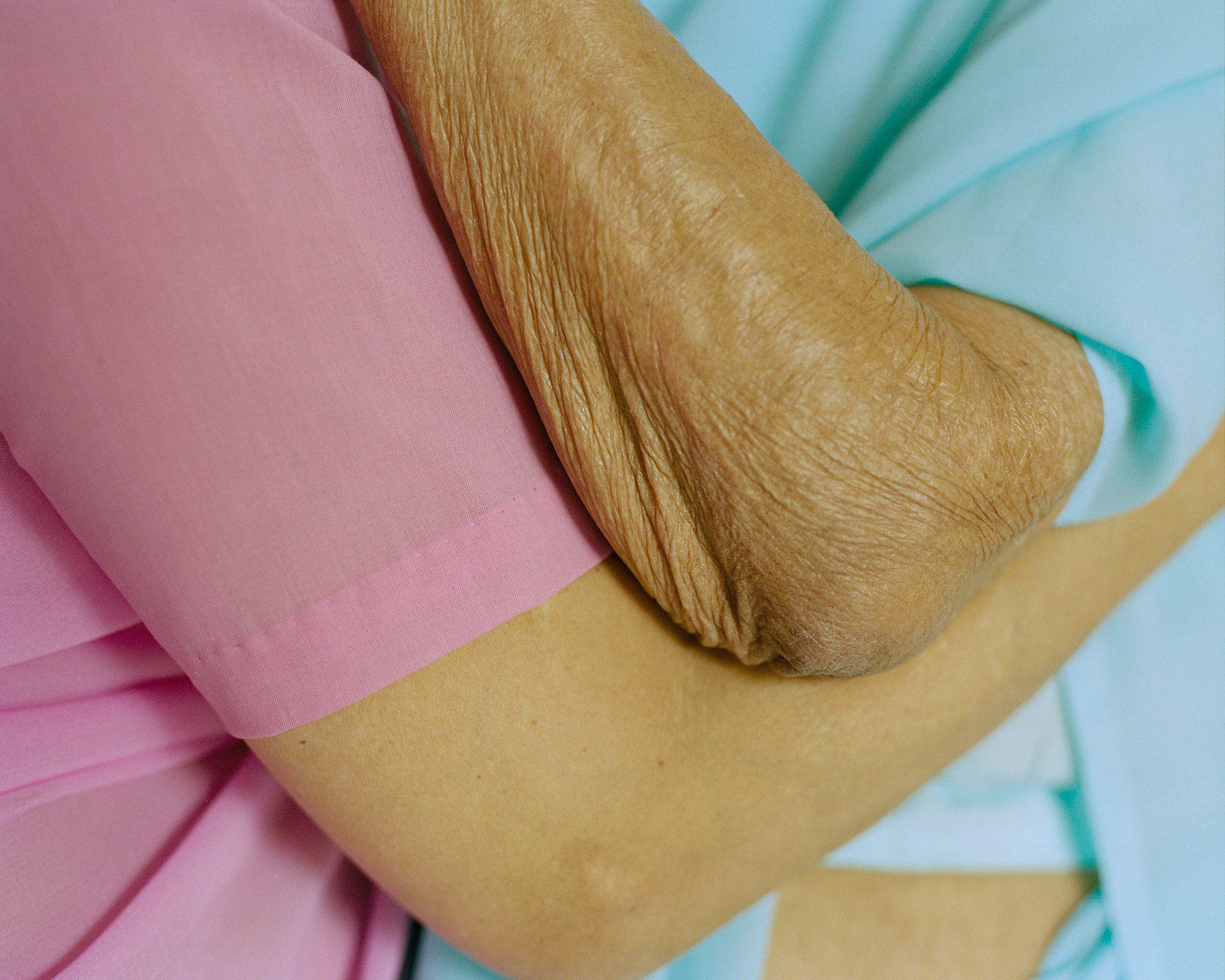
Arpita Shah, Mother’s Mother, 2018. © Arpita Shah. Courtesy of Firstsite, Colchester.
A family archive often begins with objects that survived because somebody could carry them. Passports, coins, letters, photographs, beads, dried flowers, and confectionery tins may look ordinary outside the home, yet they hold routes, relationships, and stories that official records rarely preserve.
In Nalini, Arpita Shah builds a photographic archaeology from precisely those fragments. The project follows her maternal line through her grandmother Nalini, her mother Reshma, and Shah herself, moving between India, Kenya, and the United Kingdom while acknowledging that research cannot make another person’s life fully knowable.
Three generations, several migrations
Shah was born in India and lived in Saudi Arabia and Ireland before settling in the UK. Her grandmother was born in India, spent 12 years in Kenya, and later returned to India. Geography and language separated the two women, and the project began partly from Shah’s realization that she knew little about Nalini’s youth, memories, and relationships before age and forgetfulness made those questions more urgent.
The search took Shah into attics and family homes across countries. She found photographs from the 1920s and 1930s documenting the Krishna Milk Depot, her family’s business in Nairobi, including an image of Nalini at five years old. Such discoveries do not complete the family story. They give it new anchor points from which photographs, recollections, and inherited objects can be read against one another.
When an archive becomes a portrait
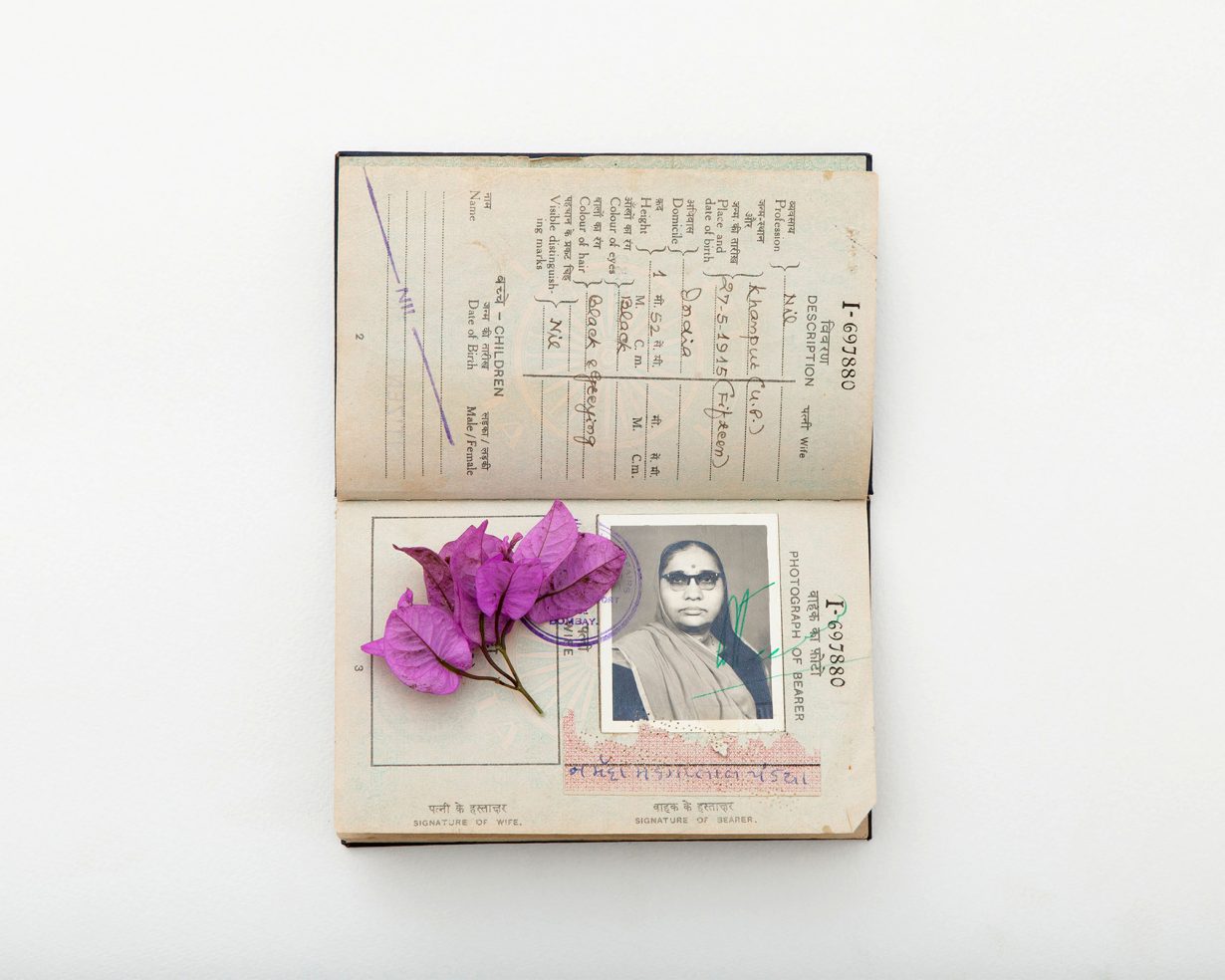
Canal Road places the passport of Shah’s great-grandmother Narmada beside dried bougainvillea gathered from the site of the family’s former Nairobi dairy farm. The document reduces a person to fixed descriptors and a small photograph. The flowers return color, place, colonial history, and the gesture of an offering to that administrative image.
Bougainvillea recurs because it traveled too, introduced from Brazil to India and East Africa under British colonial rule. The plant becomes both family symbol and evidence of a wider system of movement, showing how intimate histories are entangled with imperial ones.
Bodies carry what documents cannot
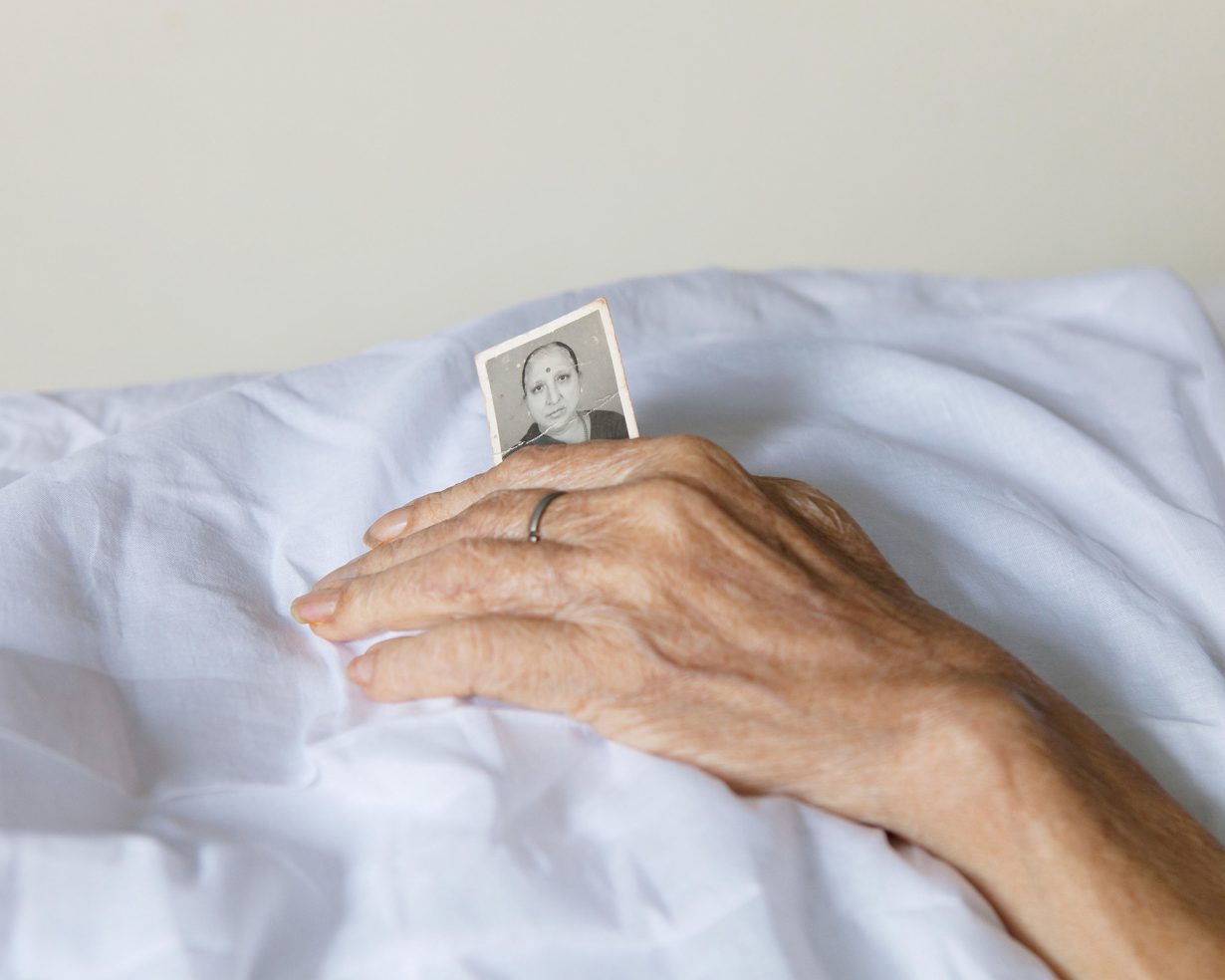
Shah often photographs hands, arms, skin, and turned bodies rather than faces. In Nalini’s Hand, an elderly hand holds a small portrait from the family archive. The living body becomes the frame for its younger photographic double, bringing different moments into contact without pretending they can be reconciled.
Mother’s Mother makes that connection even more physical. An older forearm and a younger one interlock against pink and pale blue fabric. Cropped tightly, the image refuses individual identification while making age, touch, care, and descent intensely visible. The absence of faces keeps the work from functioning as conventional family portraiture; its subject is the relationship itself.
Flowers for the women who came before
The title Nalini means lotus in Sanskrit. Across the series, flowers appear as names, transplanted species, metaphors for the female body, and offerings connected with Hindu practice. They allow Shah to move between celebration and decay, joining the cycles of a plant to the vulnerability of memory and flesh.
After Nalini died in 2023, Shah made Nalini & Narmada, a lightbox image of funeral flowers scattered across the Narmada River at dusk. Narmada was also the name of Nalini’s mother. In an interview with Aesthetica, Shah described the image as the final frame of a decade-long journey and a farewell to her female ancestors.
A recent presentation at Firstsite in Colchester brought together 26 photographs with family pictures, saris, dried flowers, and other personal objects. The exhibition closed October 4, but Nalini continues as a Street Level Photoworks touring project. Read Mark Rappolt’s review in ArtReview for another close reading of how Shah’s images reveal and withhold at the same time.