A Pause in the Wheat: Looking Closely at Bruegel’s Harvesters
A golden field, a shaded lunch and a distant horizon: three ways into Pieter Bruegel the Elder’s 1565 painting.
By Art Vault
October 4, 2026 · 2 min read
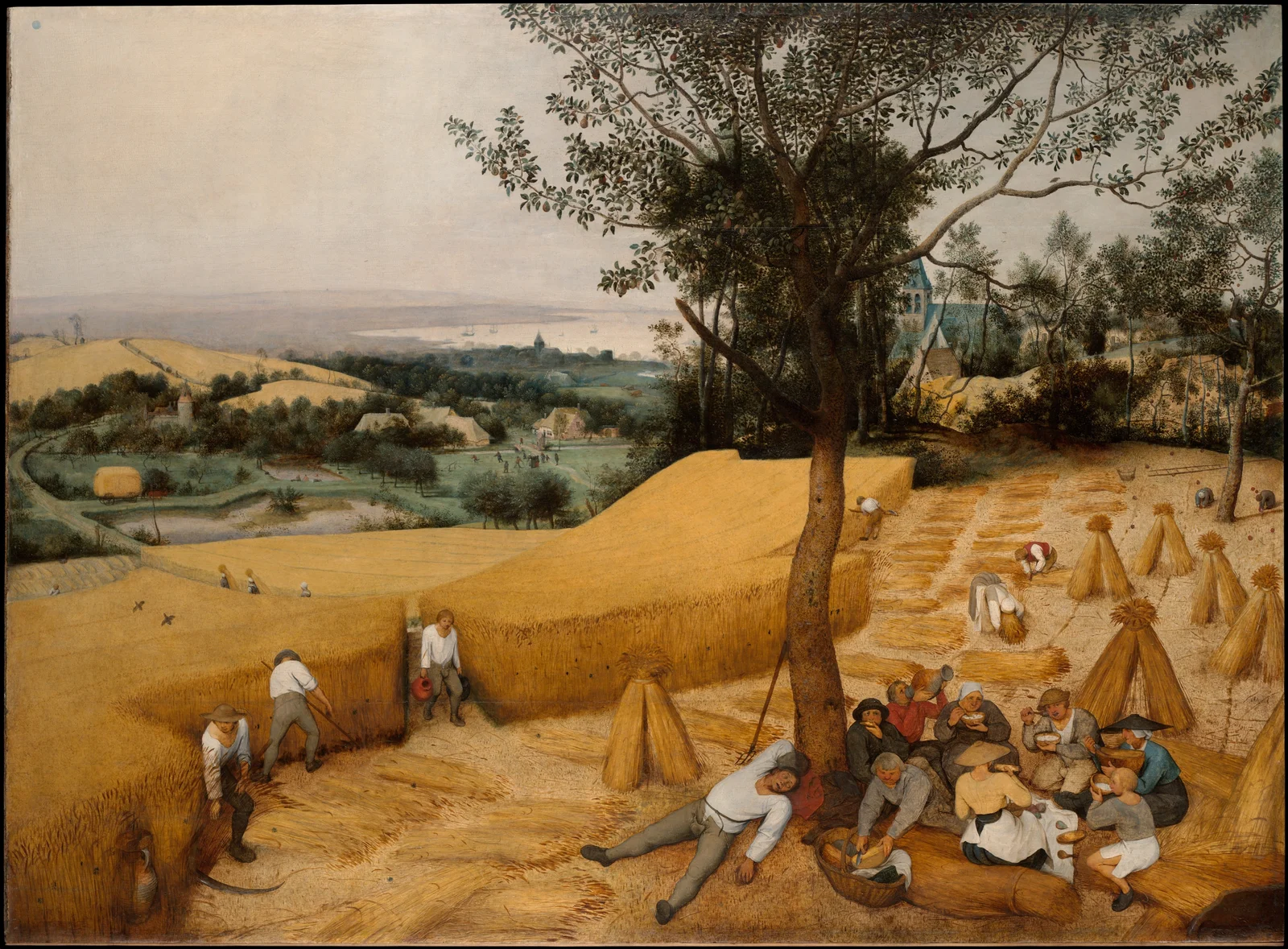
Pieter Bruegel the Elder, The Harvesters, 1565. The Metropolitan Museum of Art, Rogers Fund, 1919. Public domain; Open Access (CC0).
The first thing to notice in Pieter Bruegel the Elder’s The Harvesters is how much of the picture belongs to wheat. The broad yellow field feels almost like a single shape until small figures, cut stalks and paths begin to interrupt it. Painted in 1565 in oil on oak, the work is now in The Metropolitan Museum of Art.
Look for the pause
Start beneath the tree. Some figures eat; another stretches out on the ground. Then follow the edge of the standing crop toward the workers still cutting it. That shift between rest and activity gives the landscape a human rhythm. The harvest is a setting, but the different ways bodies occupy it keep the scene from becoming a simple pattern.
Let your eye travel
Now look beyond the field. Roads, buildings and bands of green draw the eye toward distant water. The foreground is busy and specific; farther away, the scene opens out. Try covering the resting group for a moment, then looking at the whole painting again. Their presence changes the scale: an expansive landscape becomes somewhere a person might stop for lunch.
This is an invitation to slow looking, rather than a report of a new exhibition. Open the museum’s high-resolution image and choose a small detail to follow on your next pass.
Source and full-resolution image: The Metropolitan Museum of Art collection record. Image reused under the museum’s Open Access CC0 policy. Explore more Inspiration stories.