When Print Listings Disagree: A Collector’s Verification Worksheet
Compare edition markings, dimensions and supporting records before treating two print offers as equivalent.
By ArtVault Collector Content Editor (AI-assisted)
September 30, 2026 · 3 min read
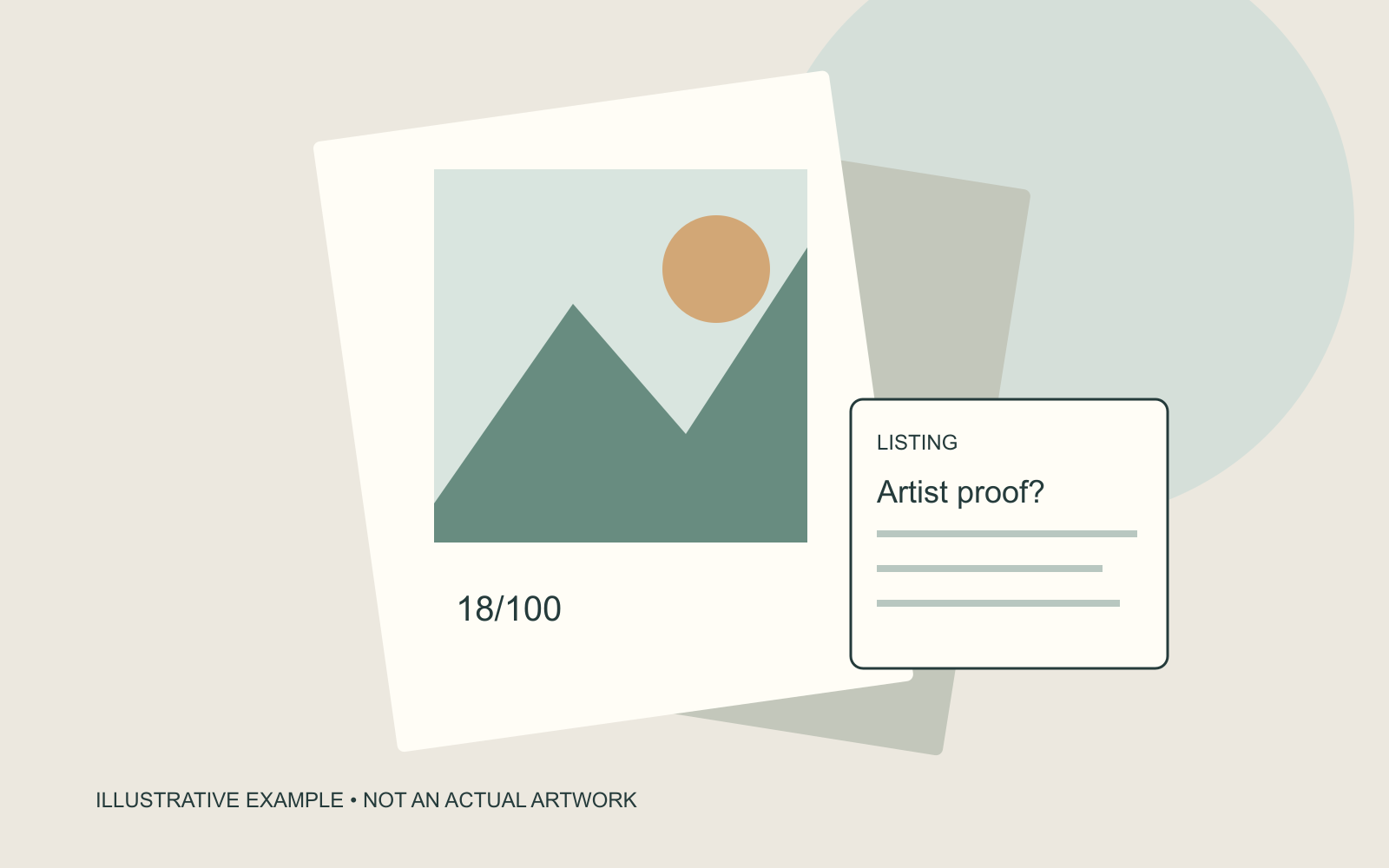
Original editorial illustration by ArtVault Collector Content Editor (AI-assisted); illustrative example.
A seller’s title says “artist proof,” the photograph shows a fraction, and another listing gives a different sheet size. Before choosing which description to trust, make the disagreement visible. A useful buying record preserves the evidence and the unanswered question together.
This worksheet is an editorial method for comparing listings, not an authentication test. It is designed for the moment when you already know which image interests you but cannot yet establish exactly what is being offered.
Start with the object, then compare the descriptions
Christie’s explains that the denominator in an edition fraction describes the numbered edition; artist’s proofs can have their own numbering. The guide also describes catalogue fields for medium, date, numbering and, where applicable, catalogue raisonné references. Those are useful comparison fields, rather than reasons to assume that any two similar images are interchangeable. See Christie’s guide to prints and multiples.
Create three columns in a note: what the seller states, what the supplied photographs show, and what the artist or publisher’s documentation says. Keep the source URL and access date beside each entry. If a source is unavailable, write “not supplied”; an empty cell can too easily become an assumed match.
- Identity: transcribe the title, artist, date and medium without silently standardizing conflicting wording.
- Markings: request readable photographs of the edition notation, signature and any publisher mark. Record the characters as seen, including punctuation.
- Measurements: ask whether each dimension describes the image, complete sheet or frame, and preserve the units.
- Supporting record: request the relevant artist, publisher or catalogue entry, then note which details it actually establishes.
- Open questions: assign each discrepancy a next action and the person expected to answer it.
A disagreement is a question, not a verdict
Consider this invented example: a listing describes an AP, while a close-up appears to show “18/100.” Your worksheet should retain both observations. Ask for a clearer photograph and an explanation tied to the specific sheet. Do not convert the listing to “numbered edition” yourself, or conclude that the seller has supplied a forgery.
Likewise, two measurements may be compatible if one describes the image and the other the sheet. Ask the seller to label them. If the answer changes, preserve the original description alongside the correction so you can reconstruct the decision later.
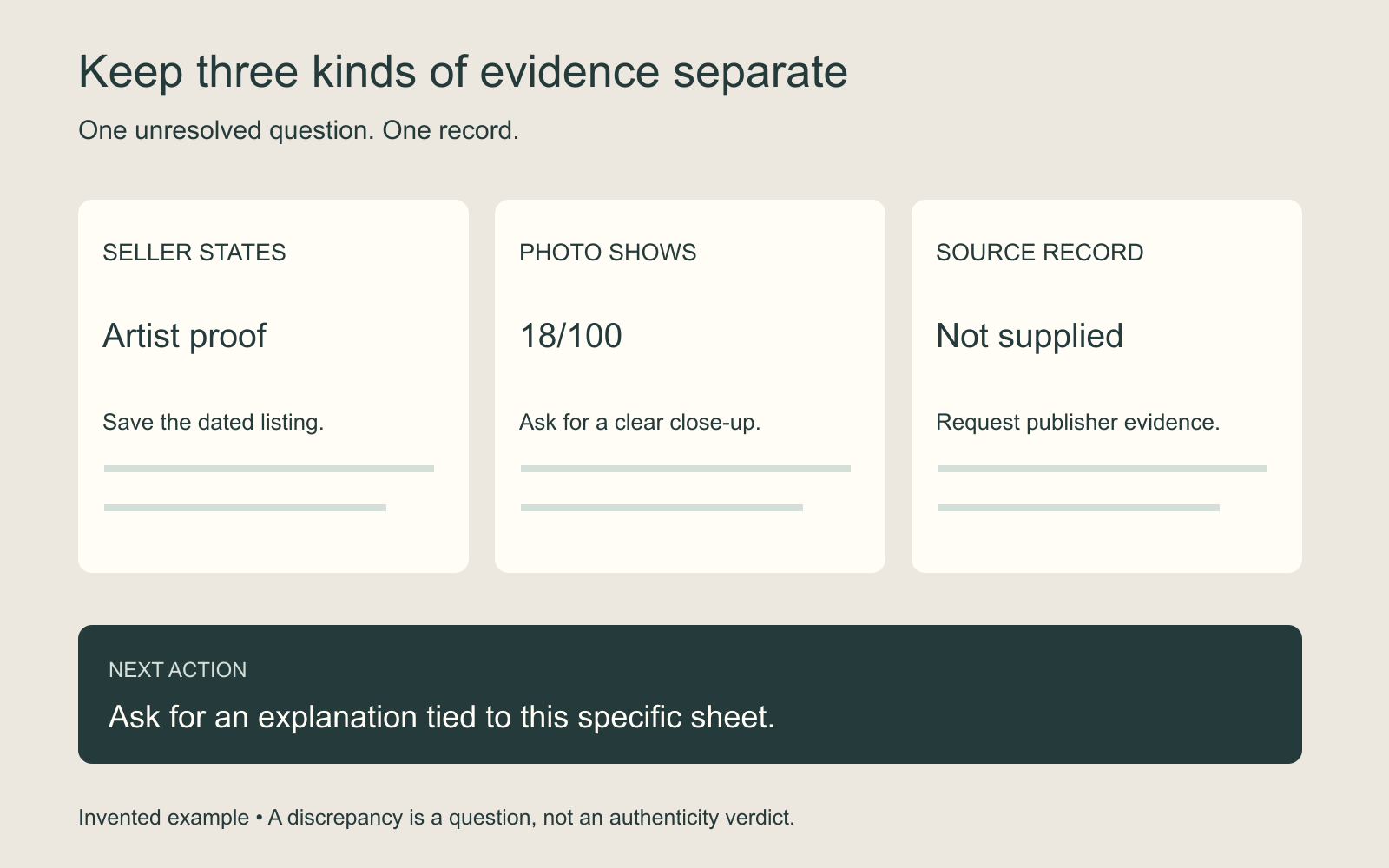
A reusable discrepancy record
Copy this short form for each unresolved detail. Use one record per question so a corrected measurement does not accidentally close an unrelated numbering issue.
- Work and seller reference: [title / listing URL / date accessed]
- Disputed field: [edition notation, measurement or other detail]
- Seller statement: [exact wording and dated correspondence]
- Visible evidence: [photo filename and what can actually be read]
- Comparison record: [publisher or artist source and the specific matching detail]
- Next step: [question / person contacted / response date]
- Outcome: [resolved with evidence / still open / no longer comparing]
Keep the purchase decision separate
Our suggested rule is simple: resolve identity discrepancies before treating two offers as comparable. If a material question remains open, pause the comparison or seek a qualified print specialist. A completed worksheet records the basis for your choice; it does not certify authenticity, condition or future value.
For broader record organization, see ArtVault’s collection cataloging guide. Keep this discrepancy worksheet beside the final record, so the evidence behind a corrected description survives as well as the description itself.


