Wade and Leta Turn Shanghai Sculpture into a Place to Play
Catching Feelings turns bold geometry into slides, spinners and a shared outdoor space at the 2026 Jing’an International Sculpture Project.
By ArtVault Collector Content Editor
November 27, 2026 · 3 min read
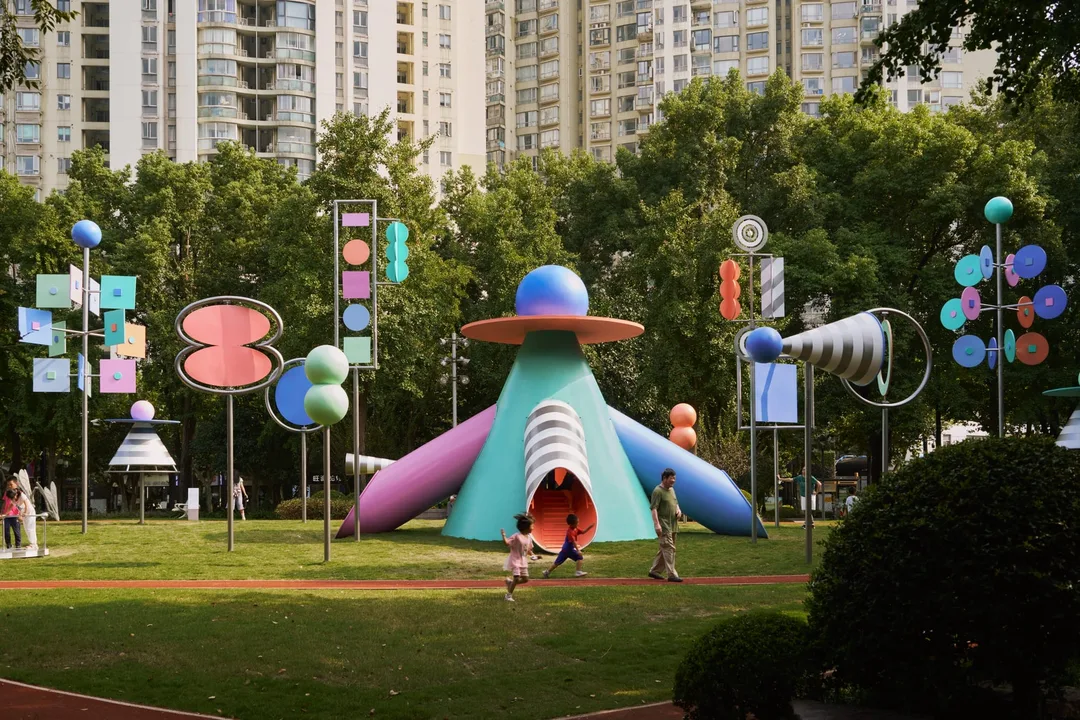
Photograph courtesy of Wade and Leta, via Colossal.
In Shanghai’s Jing’an Sculpture Park, a turquoise tower sends slides out in four directions while colored discs and striped forms rise around it. This is Catching Feelings, Wade and Leta’s 2026 installation for the Jing’an International Sculpture Project. UCCA’s exhibition listing places the work in Shapes of Becoming, running September 24–December 31, 2026. It is an ongoing exhibition, newly covered this week—not a November opening.
Color becomes something to navigate
The artists describe a setting activated by its users, with a four-sided slide, ground spinners and aerial bars. Their project record lists steel, aluminum and automotive paint, with fabrication by UCCA. Those material facts matter: the apparently lightweight graphic shapes are built objects encountered at the scale of a body.
Look at the two photographs together. The broad view places the installation against apartment buildings; the closer angle separates its discs, spheres, rails and slide mouths. Repeated circles make a visual rhythm, but the different heights interrupt any simple reading from left to right. A viewer can recognize the palette from a distance, then discover a much less orderly set of routes on approaching it. That shift—from seeing a composition to choosing a path through it—is the work’s most compelling invitation.
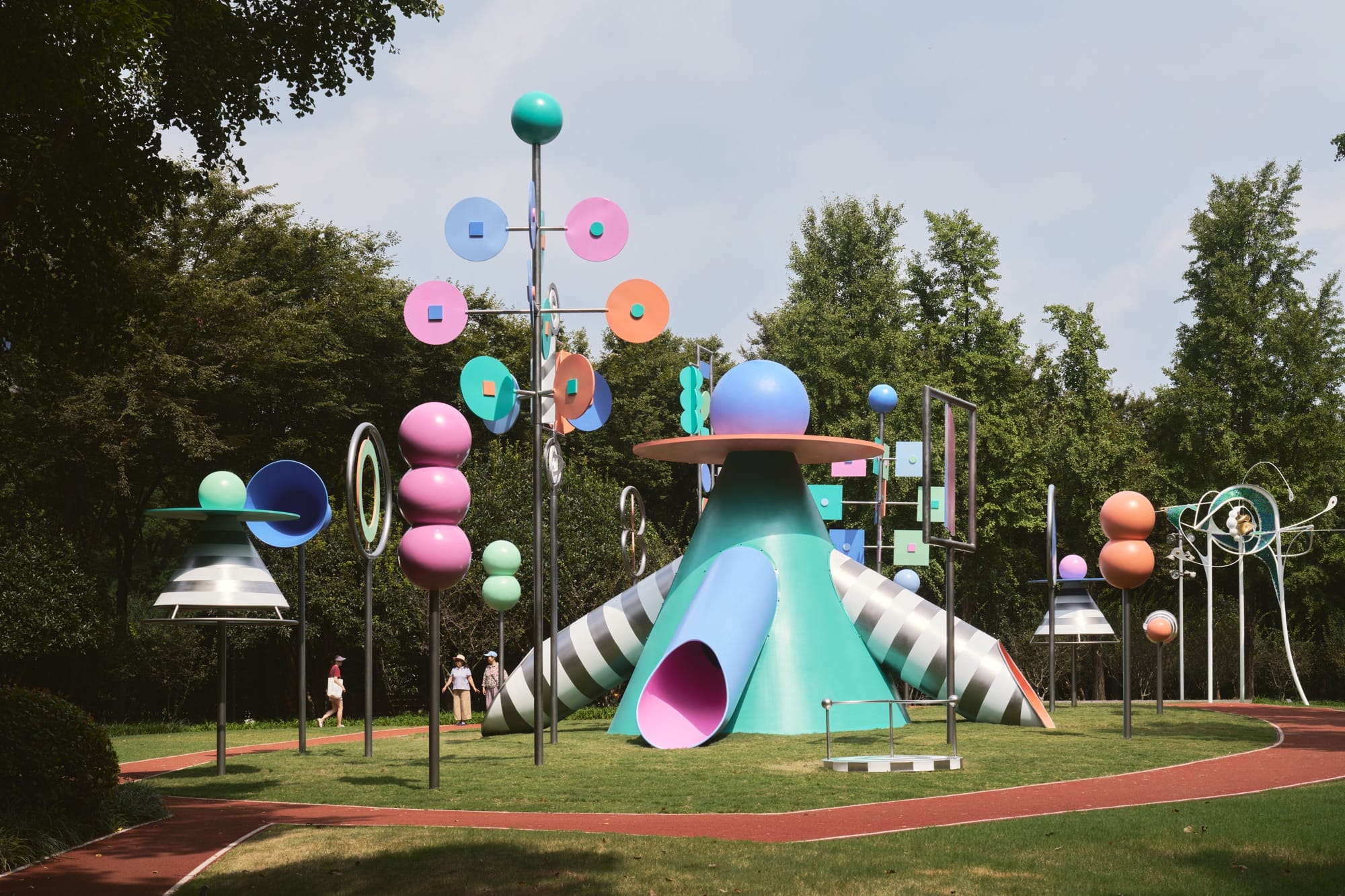
A public sculpture with room for activity
On their practice page, Wade and Leta describe backgrounds in graphic design and photography and a practice spanning sculpture, painting, installation and spatial design. Here, graphic clarity becomes a way to distinguish elements within a shared outdoor space. A circle can operate as a bright punctuation mark in a photograph while its surrounding structure offers another experience to someone standing beside it.
The artists say their earlier kinetic projects used wind or motors; this installation instead makes people’s movement central. That is their account of the design, not evidence that every visitor has the same response. The photographs show an inviting environment, but cannot establish accessibility, supervision or operating conditions.
Place the work in its exhibition
UCCA identifies the Jing’an project as a biennial, with 36 works by 33 artist groups across the park and other district sites. Colossal’s November 25 coverage supplies the recent reporting context and the credited photographs reproduced here. Consult the organizer for current visiting information; exhibition dates do not guarantee access to every interactive element at every hour.
For another approach to sculpture’s relationship with its surroundings, read ArtVault’s Meg Webster article on soil, wax and living plants. The comparison is useful: notice which parts of an installation are objects, which are its setting, and which only emerge when someone moves through it.