When Human Remains Become Museum Objects
Reliquaries, funerary sculpture, and museum cases reveal how presentation turns human remains into evidence, memory, or devotion.
By Weston Deboer
October 22, 2026 · 3 min read
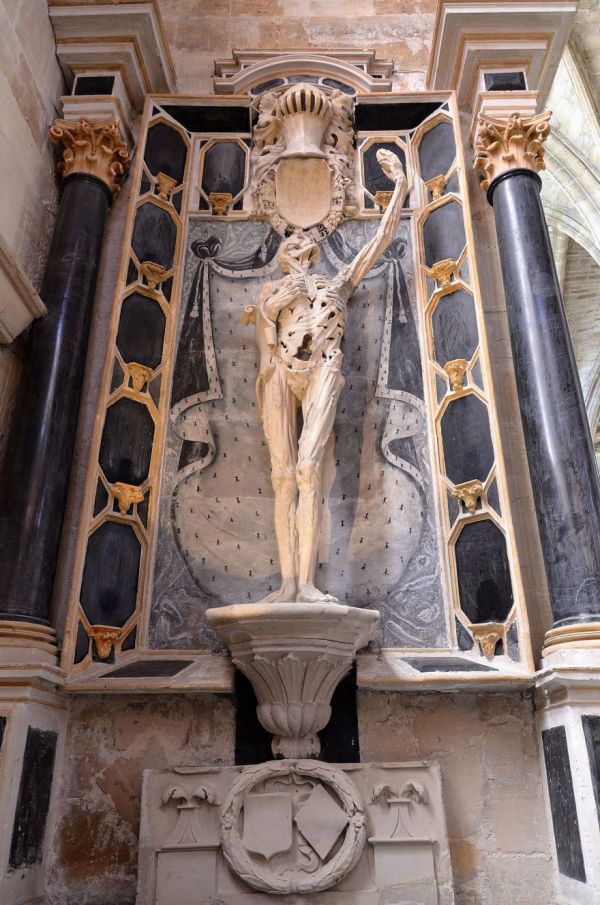
Ligier Richier, Transi de René de Chalon, 1547. Photo by Patrick, CC BY-SA 2.0.
A preserved body part is never displayed neutrally. Put it beneath glass and it becomes evidence. Set it in gold and it becomes a relic. Place it inside a monument and it can stand for an entire life, institution, or belief system. A new Atlas Obscura guide to preserved remains around the world, highlighted by Neatorama, brings these sharply different modes of presentation into the same frame.
The guide moves among medical museums, churches, temples, cemeteries, and anatomical collections. Its subjects include fragments of Abraham Lincoln’s skull, slivers of Albert Einstein’s brain, Chopin’s heart, Galileo’s fingers, saintly relics, and bodies preserved by peat bogs. What connects them is not anatomy alone but the display structures built around it.
A sculpture made to carry a heart
The most visually commanding example is Ligier Richier’s Transi de René de Chalon, completed in 1547 for the Church of Saint-Étienne in Bar-le-Duc, France. The funerary sculpture presents the young prince not as a serene ideal but as a standing cadaver, with exposed ribs, torn flesh, and one arm raised toward heaven. Its gesture once supported a heart-shaped reliquary said to contain René de Chalon’s heart; the organ was lost or stolen during the French Revolution.
The work belongs to the tradition of the transi, or cadaver monument, which confronts bodily decay rather than disguising it. Richier’s figure makes the absent heart central. Even after the relic disappeared, the stone body continued to organize the viewer’s attention around the space where it had been.
Sacred anatomy
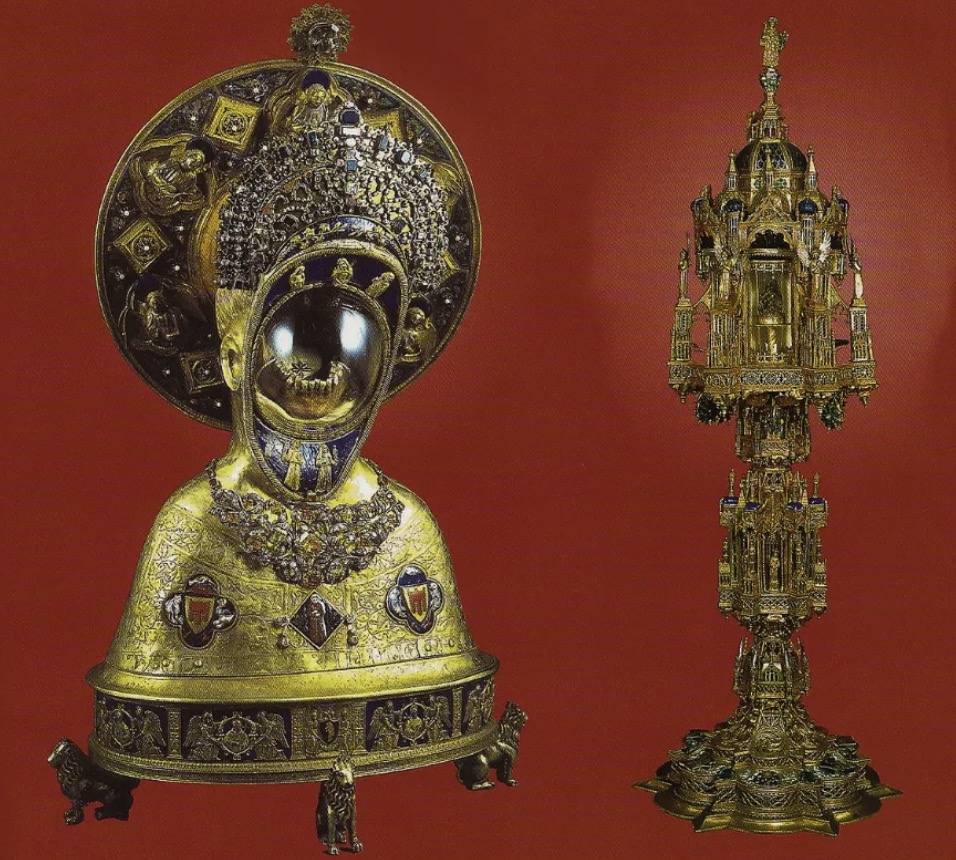
In Padua, the preserved tongue and jaw of Saint Anthony are surrounded by intricate goldwork. According to the Basilica of Saint Anthony, the saint’s tongue was found intact when his remains were transferred in 1263. The survival of an organ associated with his celebrated preaching was interpreted as a sign of spiritual merit.
The reliquary gives that interpretation a material form. Miniature architecture, precious metal, and careful illumination do more than protect the remains: they establish how the object should be approached. The display does not ask for clinical observation. It asks for veneration.
A secular saint of science
Galileo’s middle finger adopts much of the same visual language for a different kind of authority. The digit was removed in 1737 when the astronomer’s body was transferred to a monumental tomb in Florence. It eventually entered what is now the Museo Galileo, where it stands upright inside a glass cup with gilt decoration on a marble base.
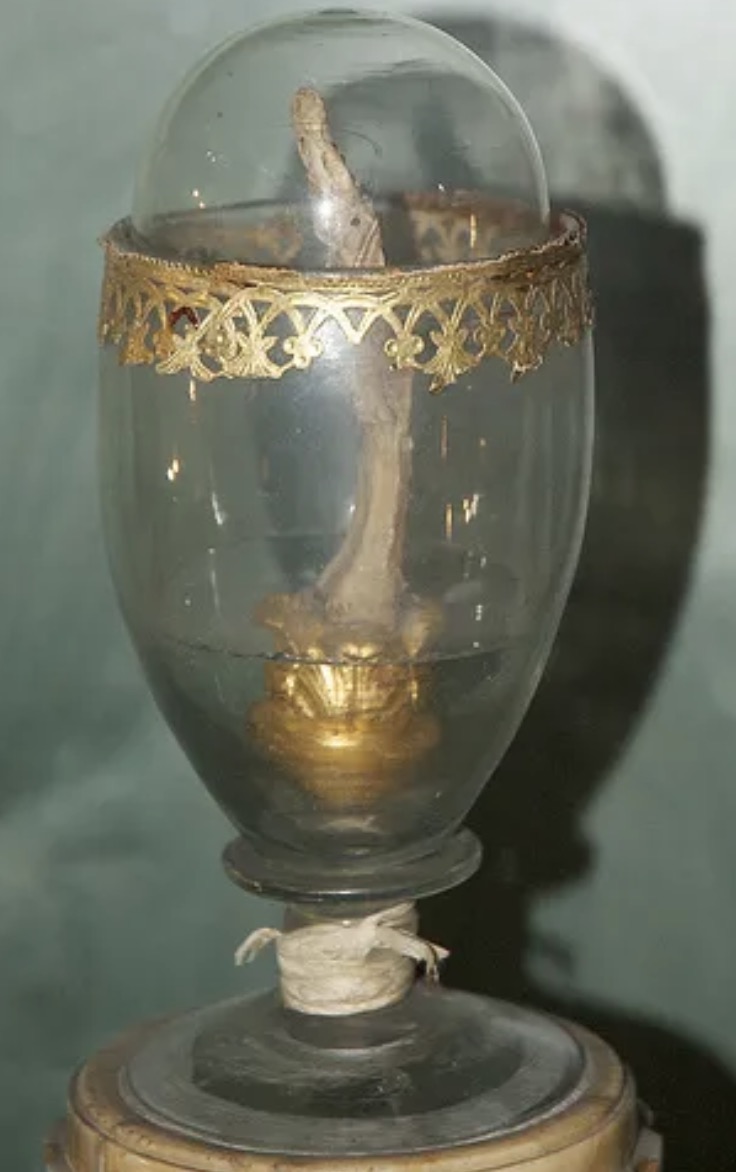
The museum describes the object as an example of Galileo’s celebration as a hero and martyr of science. The case borrows the grammar of a sacred relic while redirecting devotion toward intellectual inquiry. A fragment of a hand that pointed instruments toward the sky becomes a compact monument to the act of observation.
The ethics remain visible
Other entries in the guide make the history of collecting harder to romanticize. Einstein asked to be cremated, but the pathologist who performed his autopsy removed and retained his brain. Medical collections can preserve knowledge while also carrying histories of extraction, unequal power, and absent consent. The question is not only what a specimen can teach, but who authorized its transformation into an object and whose wishes continue to matter after death.
That tension is why the cases, labels, architecture, and credits deserve as much scrutiny as the remains themselves. Display is an argument. It tells viewers whether they are encountering a person, a specimen, a saint, a curiosity, or a national symbol, and it can make one category appear to settle into another.
Explore the complete roundup at Atlas Obscura and the shorter source note at Neatorama.
Featured image: Ligier Richier, Transi de René de Chalon, 1547, Church of Saint-Étienne, Bar-le-Duc, France. Photo by Patrick, CC BY-SA 2.0.