Kennedy Yanko Drapes Paint Skins Through a Museum of Architecture
Kennedy Yanko’s salvaged-metal sculptures and acrylic paint skins enter a charged dialogue with monumental casts of French architecture in Paris.
By Weston Deboer
October 22, 2026 · 3 min read
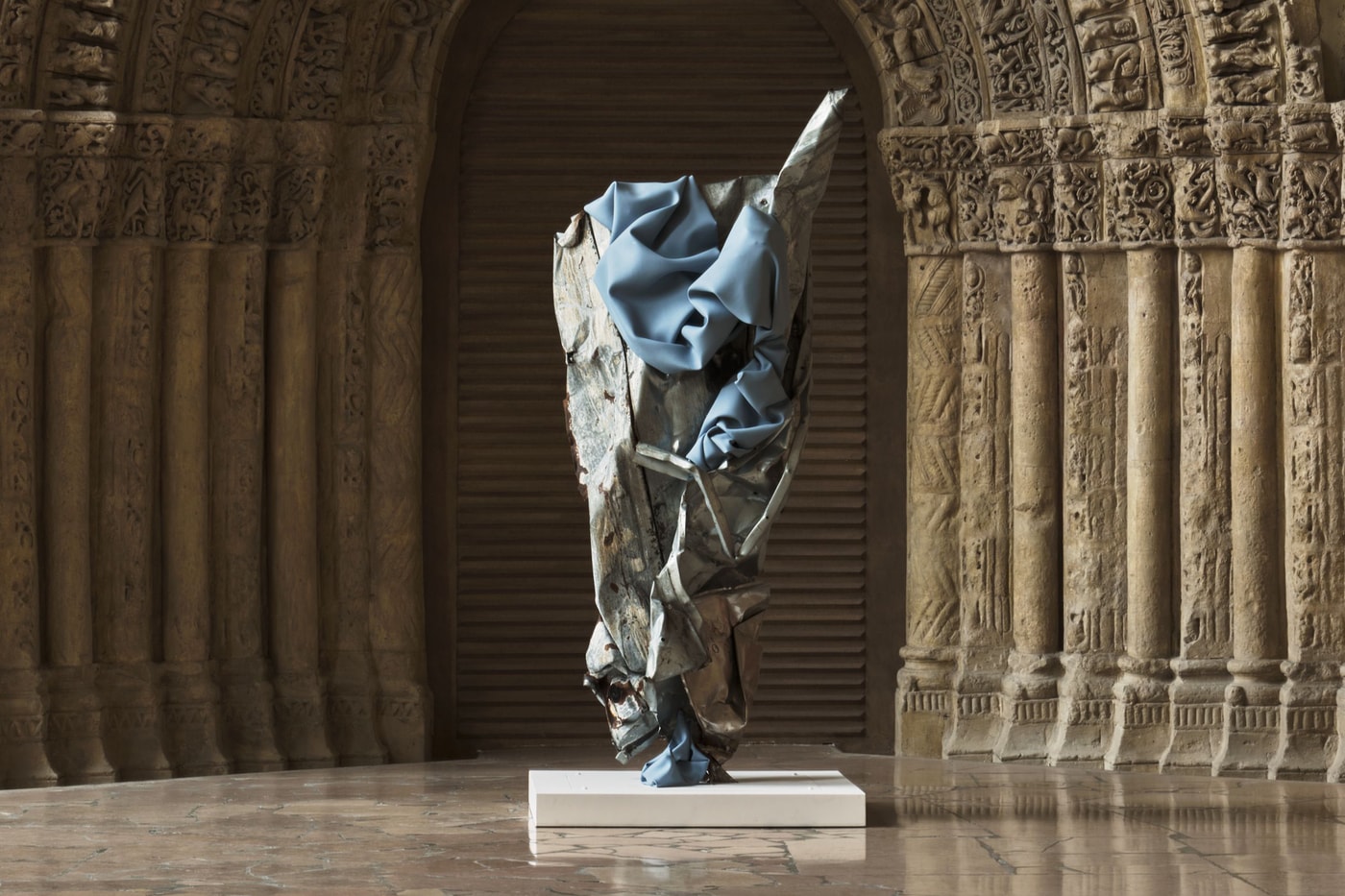
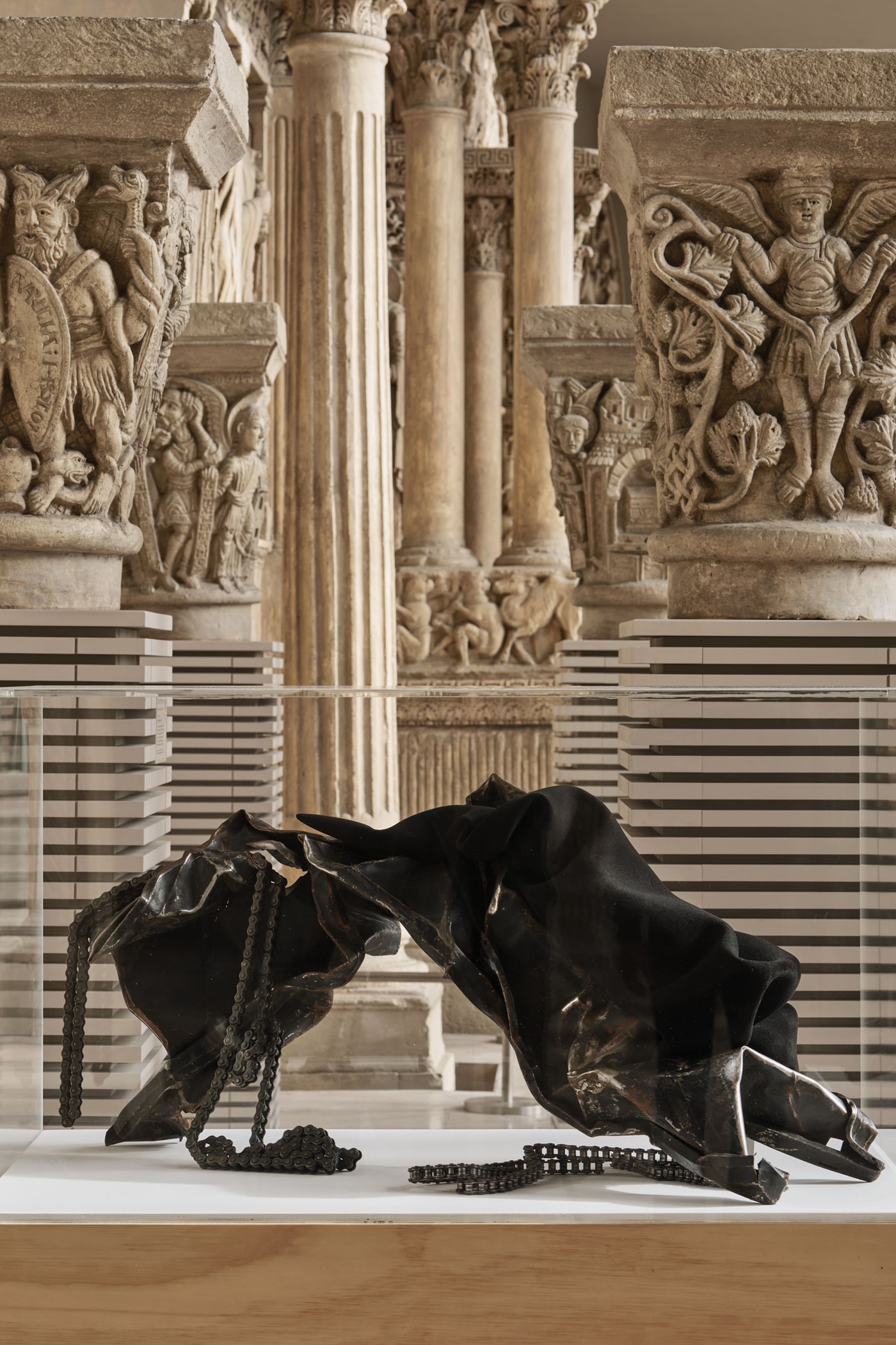
Kennedy Yanko, Ce qui nous rassemble, Paris, 2026. Photo by Adrien Dirand.
Inside Paris’s Cité de l’Architecture et du Patrimoine, fragments of salvaged metal now stand among casts of church portals, columns, angels, saints, and carved stone. The contemporary intrusions belong to Kennedy Yanko, whose exhibition Ce qui nous rassemble turns the museum’s Galerie des moulages into a conversation between material memory and transformation.
Yanko’s sculptures begin with discarded industrial metal that already bears bends, punctures, oxidation, and evidence of use. She combines those rigid remains with “paint skins,” thick sheets of poured acrylic paint formed separately and handled like fabric. Draped, folded, and pulled through metal armatures, the color appears soft enough to wear even as the surrounding structure retains the force of machinery.
Architecture becomes an active partner
The museum’s setting does more than supply a dramatic backdrop. Its full-scale casts preserve the surfaces of French monuments while also revealing how architecture is translated, copied, supported, and staged. Yanko’s sculptures occupy thresholds and approach the carved portals at human scale, extending the museum’s own interest in structure, skin, and reproduction.
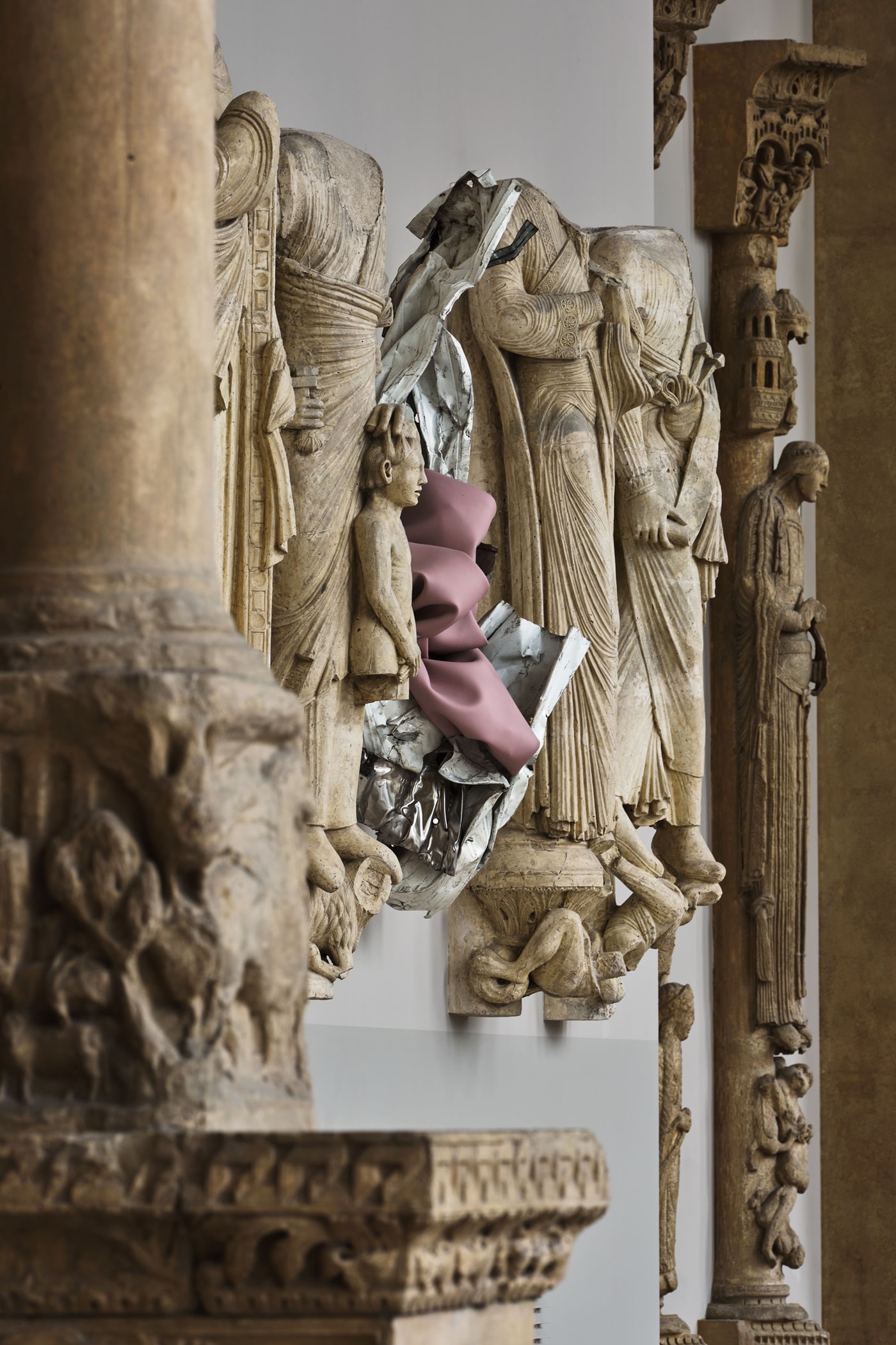
In one gallery, a cool blue paint skin gathers across a battered metallic body before an ornate portal. Elsewhere, a black form stretches low beneath a field of columns, while a pink fold appears to emerge from between stone figures. The pairings sharpen the differences between materials, but they also find shared gestures: drapery carved in stone, metal collapsed into clothlike curves, and acrylic surfaces that hold their shape like architecture.
Mary Magdalene as a figure of revision
The new body of work draws on Mary Magdalene, a figure repeatedly rewritten through religious and cultural history. Yanko approaches that unstable legacy through themes of devotion, sexuality, mysticism, and agency. Rather than illustrating a single episode, the sculptures use material rupture and recombination to ask how inherited narratives can be cleared, recalibrated, and made active again.
That process aligns with the title, which translates as “what brings us together.” The works hold unlike states in suspension: weight and movement, control and accident, industrial force and bodily vulnerability. Their unity does not erase the history of the scrap. It depends on allowing damage, pressure, and previous use to remain visible.
A public program across Paris
Curated by Matthieu Poirier, Ce qui nous rassemble is part of the Art Basel Paris Public Program. The exhibition opened October 16, 2026, and remains on view through January 3, 2027. The museum describes the presentation as part of its continuing dialogue between architecture and contemporary art.
Read the official exhibition listing at the Cité de l’Architecture et du Patrimoine, Art Basel’s interview with Kennedy Yanko, and the original report from Hypebeast.
Featured image: Installation view of Kennedy Yanko, Ce qui nous rassemble, Cité de l’Architecture et du Patrimoine, Paris, 2026. Photo by Adrien Dirand.