Nearly 4,900 Russian and East European Posters Are Online at Princeton
Princeton University Library’s digital collection brings together thousands of Russian and East European posters across 18 languages and 17 geographic o...
By Weston Deboer
October 27, 2026 · 3 min read
Sources, automated assistance and corrections · Report an error.
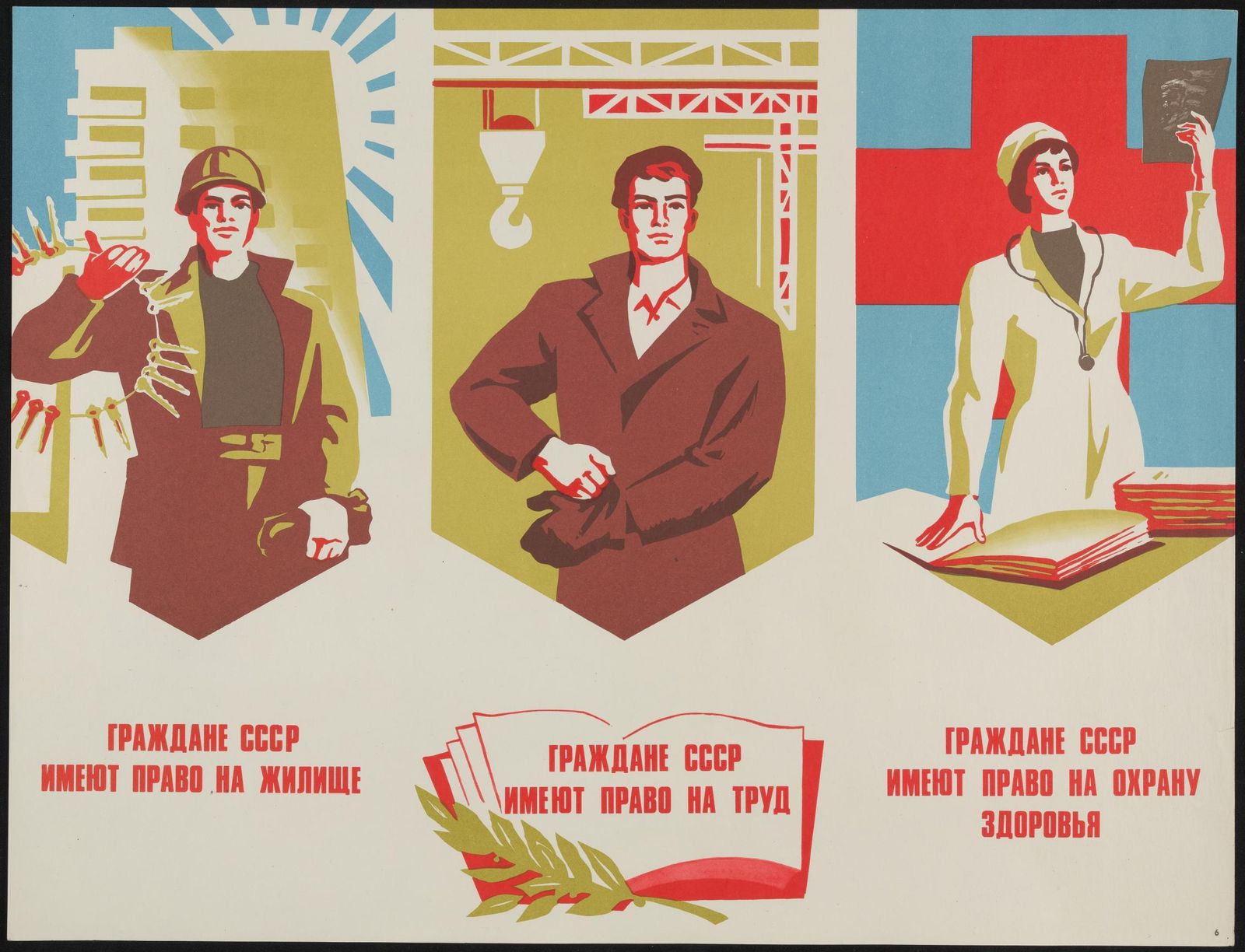
Grazhdane SSSR imeiut pravo na trud, date unknown. Illustrator and publisher unidentified. Russian and East European Posters Collection, Princeton University Library.
Princeton University Library’s Russian and East European Posters collection turns nearly 4,900 pieces of printed ephemera into a searchable visual history. The archive moves well beyond the familiar image of heroic workers and red banners, encompassing advertisements for films and performances, public-information campaigns, cultural policy, health, education, science, agriculture, and everyday civic life.
The current catalog contains 4,896 items from 17 geographic origins and in 18 languages. Most are Russian, but the collection also includes material in Ukrainian, German, English, French, Belarusian, and other languages. Filters for subject, format, language, and place make the archive useful both as a design resource and as a record of how institutions attempted to address mass audiences.
Rights rendered as graphic certainty
One featured poster, Grazhdane SSSR imeiut pravo na trud (“Citizens of the USSR Have the Right to Work”), divides the page into housing, labor, and health care. A construction worker, factory worker, and medical professional are flattened into crisp blocks of blue, olive, red, and brown, each paired with declarative constitutional language.
The catalog does not identify its illustrator, publisher, or year. That gap is part of the archive’s value: digitization makes the image available for comparison while keeping uncertainty visible rather than quietly inventing attribution.
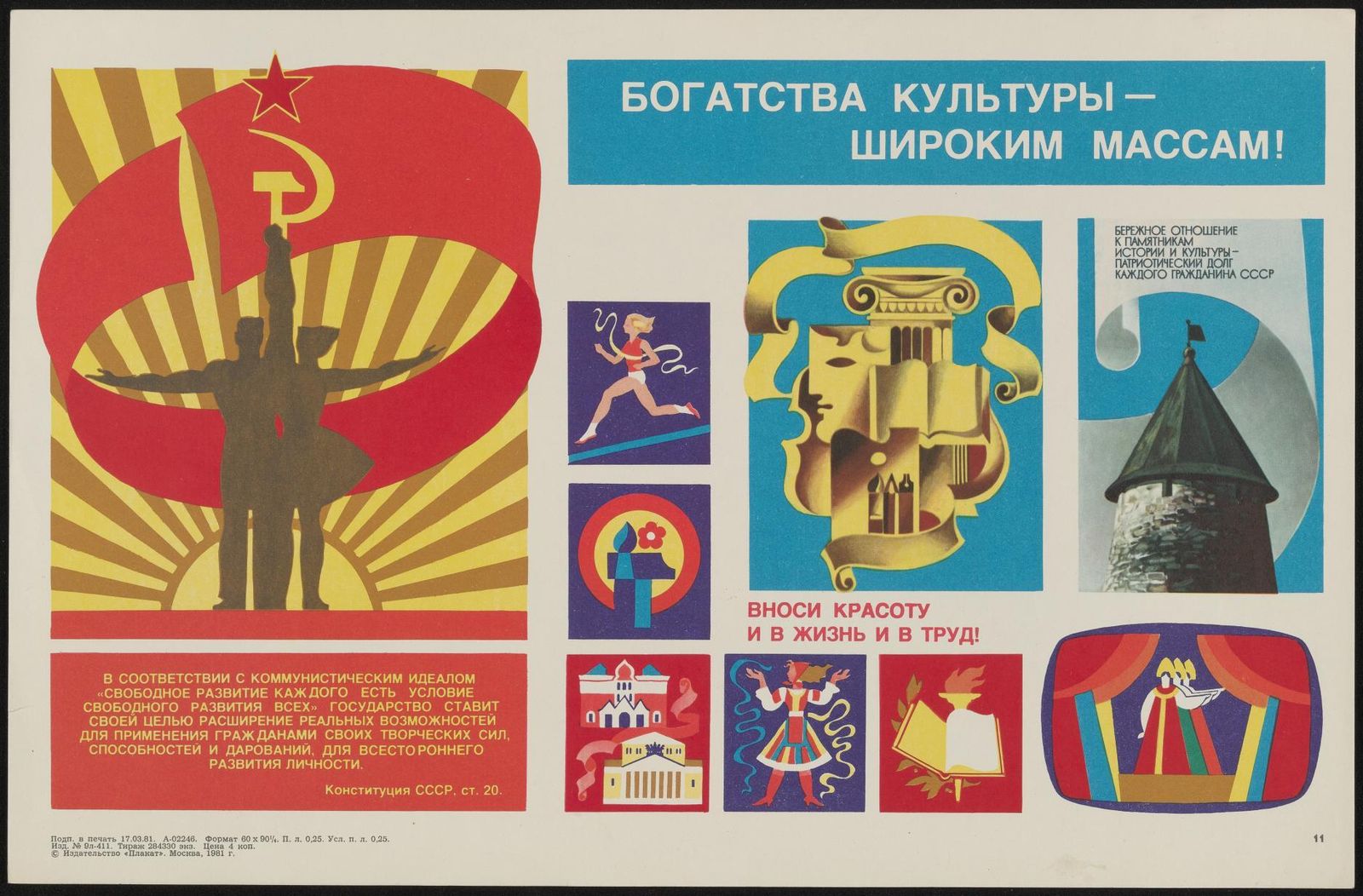
A collage of sanctioned culture
The 1981 poster Bogatstva kulʹtury — shirokim massam! assembles ballet, theater, books, folk costume, architecture, athletics, and historic preservation into a modular grid. Its visual grammar is closer to an illustrated dashboard than a single monumental scene, suggesting culture as a coordinated public system whose many parts are meant to appear mutually reinforcing.
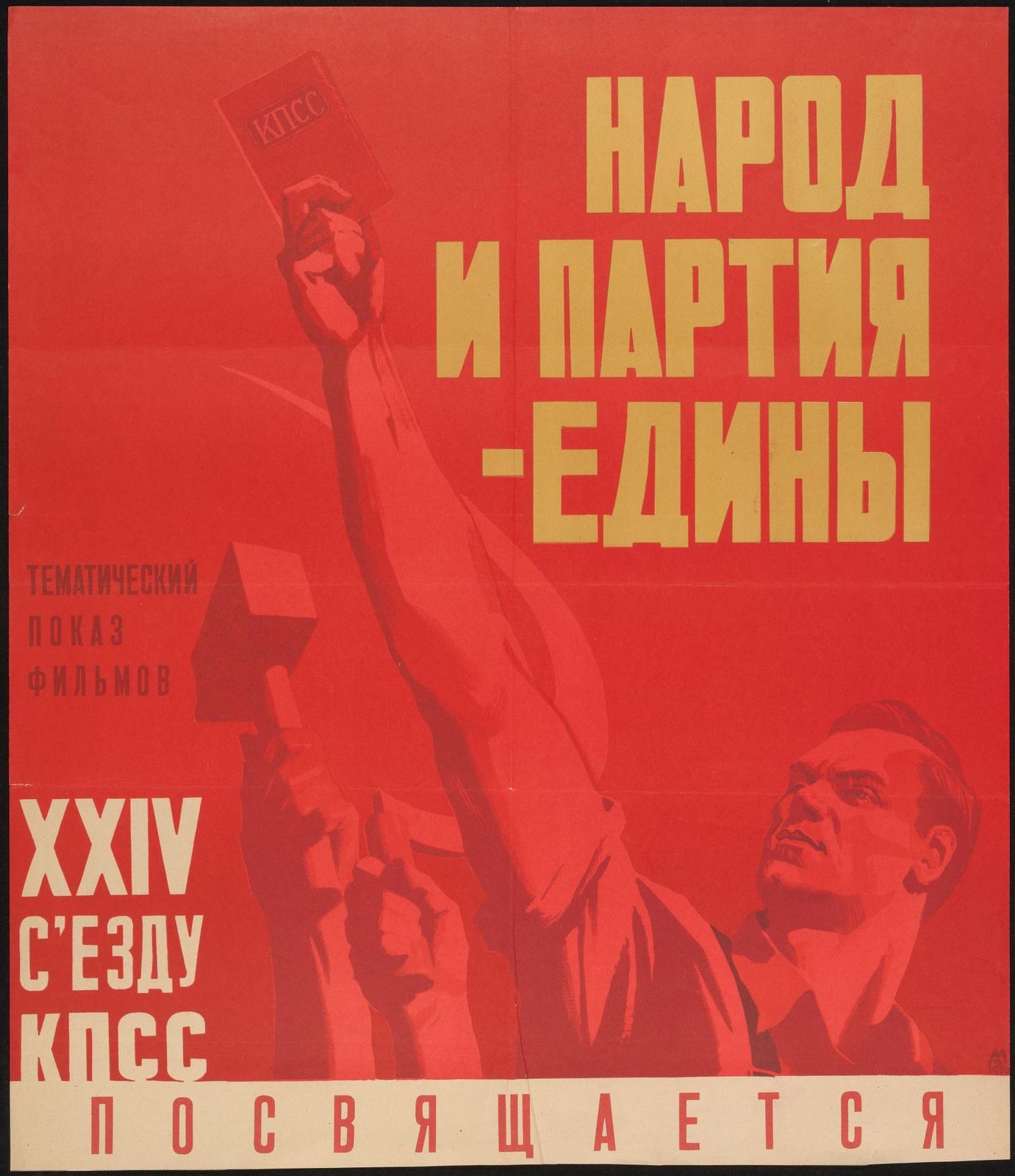
Elsewhere in the collection, design strategies range from photomontage and caricature to severe typography and brightly simplified illustration. In Narod i partiia — ediny, a worker raises a Party membership card beneath oversized yellow lettering. Repeated symbols do much of the rhetorical work: books stand for political education, machinery for progress, monumental architecture for permanence, and carefully staged crowds for social unity.
An archive built for close comparison
The catalog’s scale encourages a different kind of looking than a poster exhibition. A visitor can move from labor to cinema, narrow results by language, or compare how the same political themes were redesigned over time. High-resolution scans preserve printing textures, registration shifts, edge wear, and other physical details that reveal the posters as handled objects rather than frictionless digital graphics.
Princeton states that it claims no copyright governing the digital resource and provides it on a noncommercial, open-access basis for fair-use academic and research purposes. Individual records may still be labeled in copyright when rights holders are unlocated or unidentified, so each item page remains the best source for current rights and attribution information.
Browse the full Russian and East European Posters collection at Princeton Digital Collections.