Ensor’s Shivering Skeletons: A Halloween Look at an Impossible Household
A close look at Ensor’s crowded room, its inscribed title and the pale paper surrounding it.
By ArtVault Editorial
October 28, 2026 · 3 min read
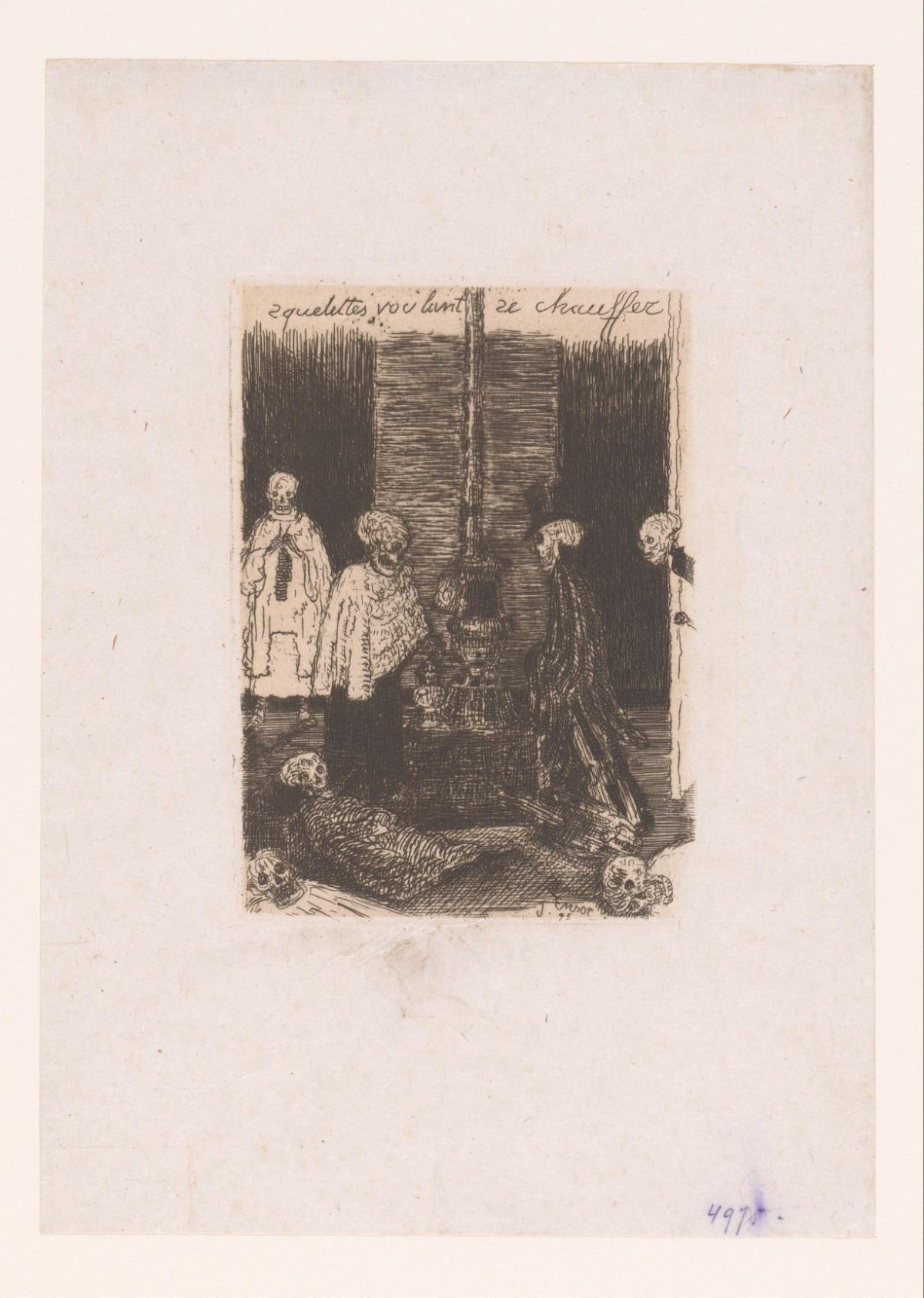
James Ensor, 1895. Rijksmuseum, RP-P-1969-14. Public domain.
A Halloween scene with an everyday problem
A stove stands in the middle of a cramped room. Around it, figures with exposed skulls lean, crouch and wait. James Ensor makes the skeleton do something stranger than frighten a passerby: seek a little domestic comfort. For Halloween, this historical print offers a quieter kind of unease, built from an ordinary action that its characters can no longer plausibly need.
The Rijksmuseum dates this etching to 1895 and records its French title on the object as Squelettes voulant se chauffer. Its collection number is RP-P-1969-14. This is a seasonal close look at an existing collection work, not a newly announced exhibition or discovery.
Follow the stove, then the faces
Begin at the tall pipe: it divides the room and leads the eye down to the stove. Then follow the surrounding bodies. One bends inward from the right; another huddles close on the left. A figure lies across the foreground, while skull-like faces intrude at the lower corners and from the right edge. Looking is repeatedly interrupted by another face.
Those interruptions make the room feel crowded without establishing a comfortable social gathering. Dense vertical strokes blacken its edges; horizontal lines flatten the wall behind the pipe. The central object supplies order, but the bodies refuse a neat circle around it. In our reading, the comic premise and the cramped arrangement pull against each other: an impossible household continues its daily routine.
Carnival belongs to the context, not the calendar
The Flemish Art Collection’s archived account of Ensor’s masks identifies his family’s souvenir shops and Ostend carnival processions among their sources. It describes how he changed festive disguises into vehicles for caricature and discontent. That context helps explain why a grotesque face in his work need not function simply as a monster.
Our Halloween connection is an invitation to look, not a claim that Ensor made this print for the holiday. Here, skeletal figures retain posture, clothing and habits. The unsettling part is how much ordinary life remains.
Keep the sheet in view
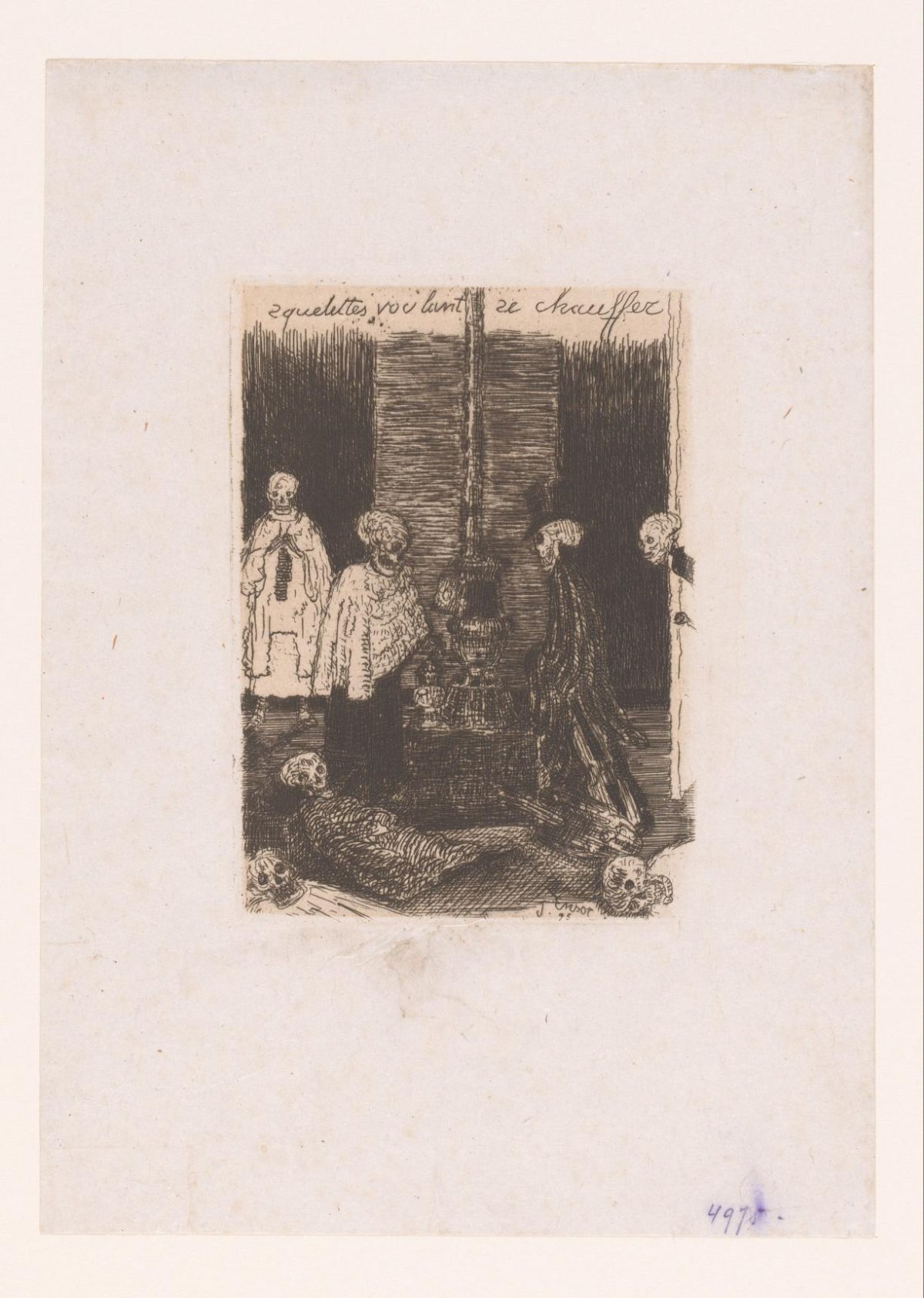
Image: James Ensor, Squelettes voulant se chauffer, 1895. Rijksmuseum, RP-P-1969-14; purchased with support of the F.G. Waller-Fonds. The museum record marks the image public domain.
The full-sheet image above gives a different experience from a tightly framed screen image: the dark little room sits inside a broad, pale margin. The handwritten title is part of that encounter. The museum records an etching on paper; its physical description specifies plate tone. The online reproduction is useful for looking, but cannot establish the condition of another impression.
For another way an artist makes the familiar uncanny, compare ArtVault’s look at Alex Pardee’s Brightmares. Ensor’s crowded interior and Pardee’s colored creatures offer different answers to the same viewing question: what makes an invented figure feel disturbingly alive?
Prepared with AI assistance and automated editorial checks under ArtVault’s standing publication authorization.