Giclée vs. Screenprint vs. Offset: What’s the Difference?
A practical comparison of giclée, screenprint and offset, with an evidence checklist for paper, ink, process and edition details.
By Weston Deboer
June 28, 2025 · 3 min read
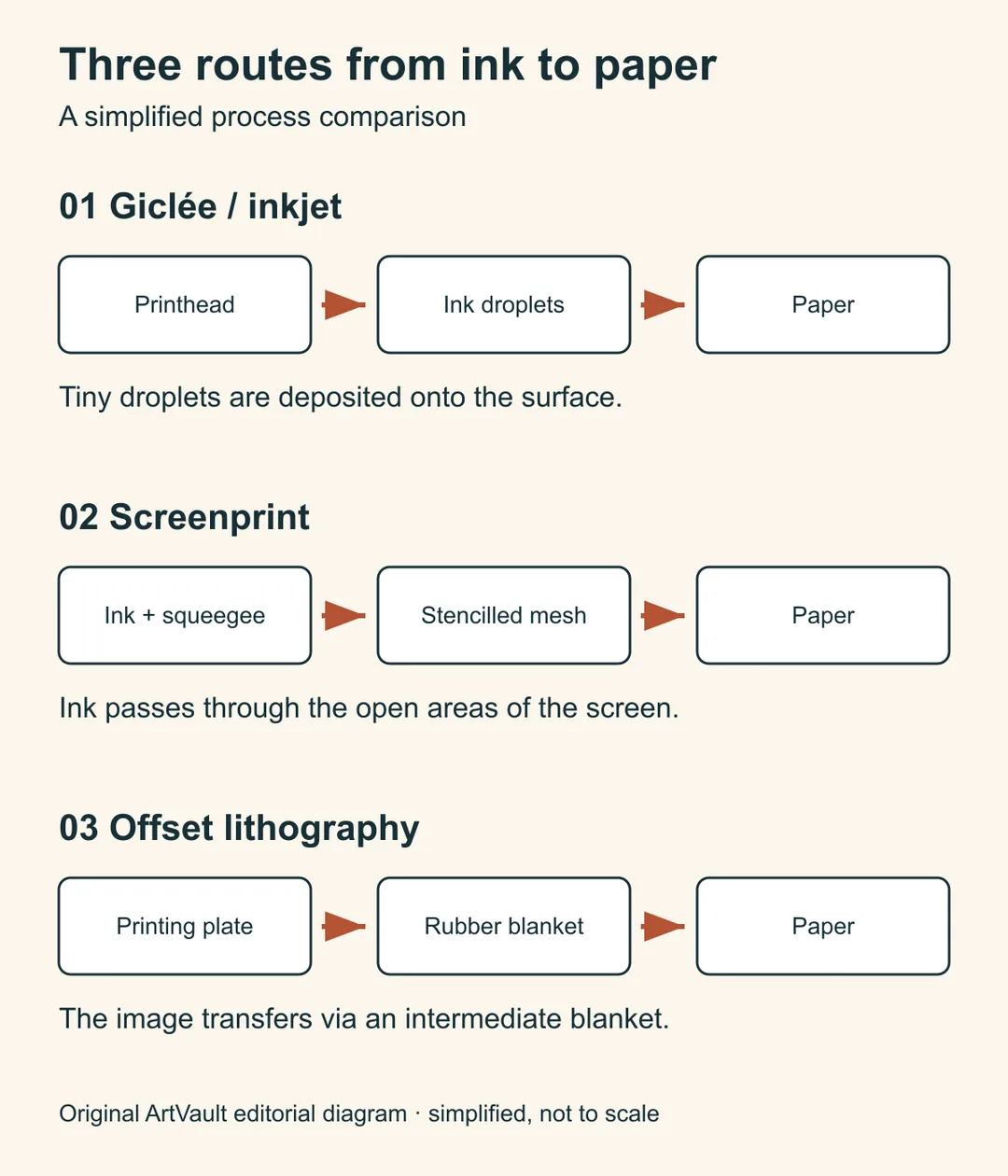
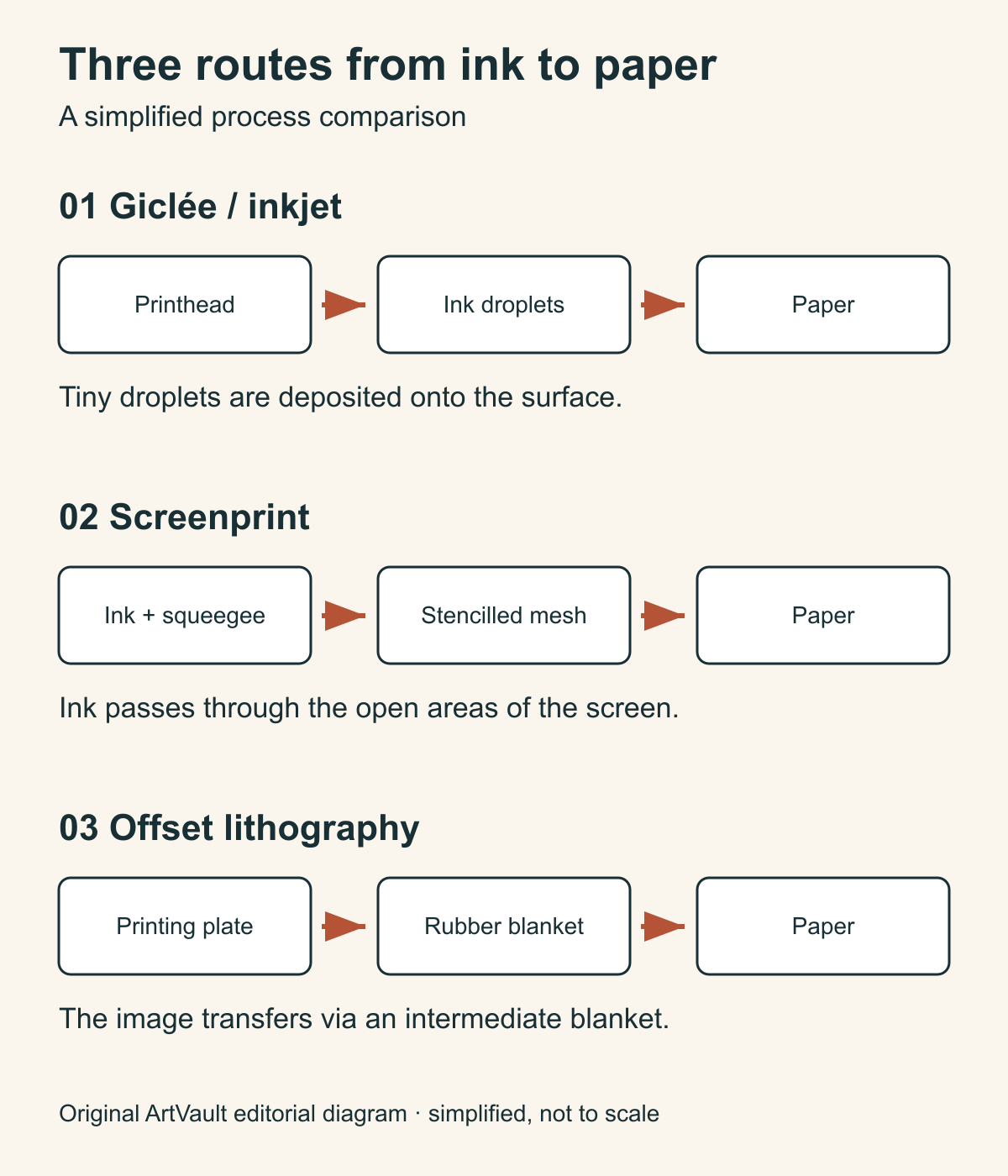
Original Art Vault editorial diagram, AI-assisted.
Giclée, screenprint and offset describe printing processes. A useful collection record separates that description from evidence about the edition, its materials and the particular sheet. Start with the publisher’s wording, then record what you can verify.
Giclée and inkjet
Giclée is a term used for fine-art inkjet printing. An inkjet printer deposits small droplets onto a support. The label alone does not identify the ink formulation or paper. Ask for those details rather than treating “giclée” as a complete materials specification.
The University of Illinois Preservation Self-Assessment Program’s digital-print guide describes different inkjet papers and both dye- and pigment-based inks. It explains that deterioration depends on the paper and ink. A generic process name is therefore not a basis for promising a particular lifespan.
Screenprint
In screenprinting, ink moves through the open parts of a prepared mesh; blocked areas prevent ink from reaching the surface. Separate stencils can be used for different colors. The Metropolitan Museum of Art explains the screenprinting process, including stencil preparation and registration.
In your record, keep “screenprint” separate from claims such as hand-pulled, signed or numbered. Record those details only when the publisher or the sheet supplies evidence. Do not use the process label as a substitute for edition documentation.
Offset and other lithography
Offset lithography transfers the inked image through an intermediate surface, commonly a rubber blanket, before it reaches paper. The Quentin Blake Centre for Illustration’s offset glossary describes this sequence.
Lithography is a broader term. MoMA’s glossary distinguishes traditional lithography from variants including offset, photo- and transfer lithography. If a listing says only “lithograph,” preserve that wording and ask which process was used rather than automatically recording “offset.”
A practical print-record exercise
Instead of ranking processes by collector value or assigning blanket archival ratings, make a short evidence record for the print in front of you:
- Process: transcribe the publisher’s exact description.
- Source: save the source page and the date you checked it.
- Materials: note any stated paper, support, ink or production details.
- Edition evidence: record the sheet’s numbering and signatures separately.
- Unanswered questions: explicitly mark details the source does not supply.
For example, if a publisher says “screenprint” but does not name the paper, your record can say “Screenprint; paper not specified in the publisher’s listing.” That is a more useful starting point than filling the gap with an assumed material or lifespan.
Use the guide to edition numbers and proofs for edition terminology, the print-listing discrepancy worksheet when sources disagree, and the artwork identification record test to check whether another reader can identify the work from your notes. These are documentation tools, not appraisals or authentication certificates.