Norman Rockwell’s 1944 Voting Scene Revives a Call to Vote for the Arts
A 1944 Norman Rockwell polling-place illustration returns as a timely, nonpartisan reminder that voting decisions shape museums, libraries, arts educati...
By Weston Deboer
November 3, 2026 · 2 min read

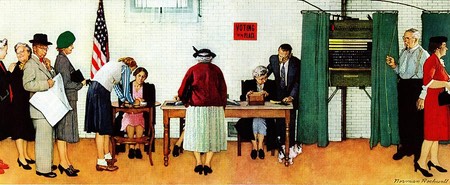
Norman Rockwell, America at the Polls, 1944. Illustration for The Saturday Evening Post. © SEPS. Editorial use.
On Election Day, a 1944 Norman Rockwell illustration offers a reminder that civic choices extend beyond candidates and ballot measures. In “Voting for the Arts?”, Lines and Colors points readers toward the public decisions that shape museums, libraries, arts education, cultural institutions, and the infrastructure that allows collections and exhibitions to circulate.
A polling place as a civic portrait
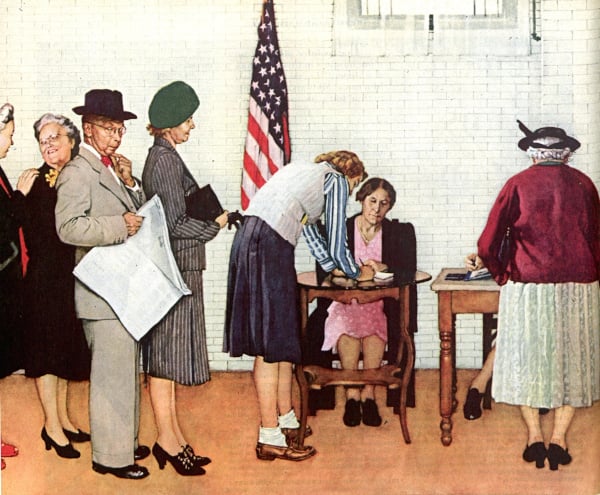
Rockwell’s America at the Polls, sometimes circulated as Voting Day, follows people through a polling place: waiting in line, checking in, entering the booth, and leaving after casting a ballot. The scene first appeared in the November 4, 1944 issue of The Saturday Evening Post. The magazine’s archive feature says Rockwell went to Cedar Rapids, Iowa, in search of a representative American setting.
Instead of depicting a speech or campaign rally, the illustration concentrates on the ordinary mechanics of participation. People occupy different stages of the process, and the modest room becomes a shared civic space. That emphasis gives the image renewed force when paired with a question about how public policy supports culture.
Arts funding is part of the ballot’s longer story
The arts are affected by decisions made at every level of government. The National Endowment for the Arts describes its work as supporting arts and arts education in communities nationwide, while the Institute of Museum and Library Services funds museums, libraries, archives, preservation, professional development, and public access programs.
Local and state choices matter just as much: school programs, library systems, municipal cultural budgets, public art, preservation, and support for community organizations all depend on elected bodies and public priorities. Voting “for the arts” is therefore less a single-box instruction than a prompt to examine what candidates and measures would do for the cultural life of a community.
A nonpartisan image with a present-tense question
Rockwell’s polling-place scene avoids telling the viewer how its subjects vote. Lines and Colors takes the same broad approach, asking readers who care about cultural institutions to carry that concern into the voting booth without naming a party. The image’s value here is not nostalgia alone; it makes civic participation visible as a sequence of small, deliberate actions.
Read the original note at Lines and Colors, explore the full 1944 series through The Saturday Evening Post, and find official voting guidance at Vote.gov.