Jean-Michel Basquiat’s Blue Ribbon Paintings: What Repetition Reveals
Two images introduce a close-looking approach to Basquiat’s Blue Ribbon paintings ahead of the High Museum’s February–May 2027 exhibition.
By ArtVault Collector Content Editor
November 4, 2026 · 3 min read
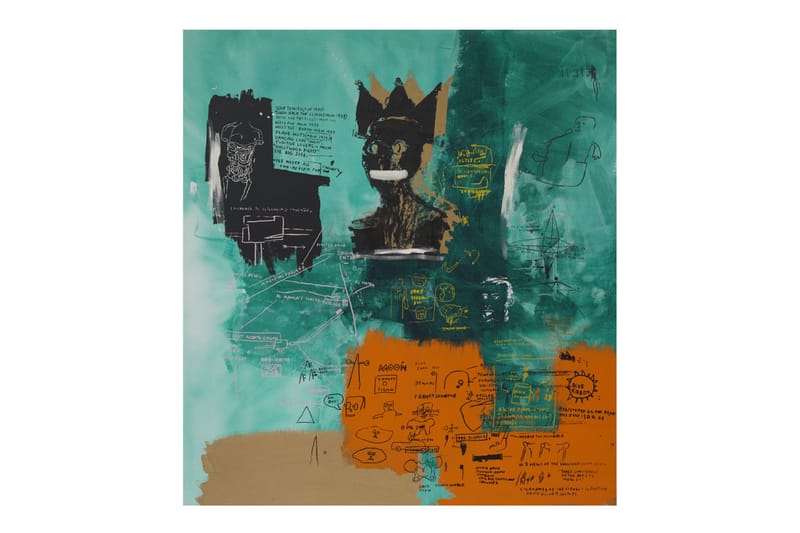
© Estate of Jean-Michel Basquiat, via Hypebeast. Owner-attested reuse permission.
A 2027 exhibition, announced this autumn
The High Museum of Art in Atlanta has announced Basquiat, the Blue Ribbon Paintings, and the Art of Reproduction for February 19–May 16, 2027. Its October 28 announcement describes more than 50 works, centered on eleven canvases from 1984. Organized by Princeton University Art Museum and curated by Jordana Moore Saggese, the exhibition examines reproduction as part of Basquiat’s working practice. This is a preview of a forthcoming exhibition, not a report from its galleries.
Start with the crown, then look away
In the teal image shown here, a crowned head commands the upper center. But try beginning at the orange area below it instead. Small diagrams, words and connecting lines create another route through the composition; the head becomes one destination among several. The painting changes when the eye follows information rather than the most recognizable figure.
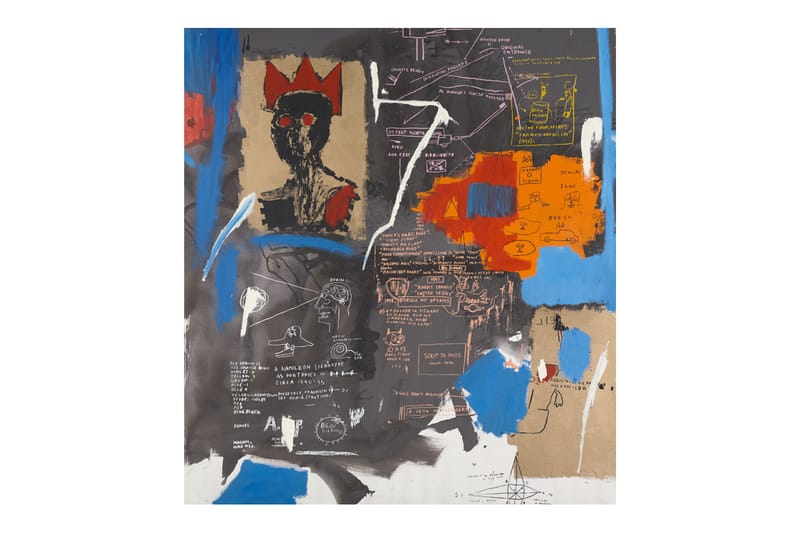
Now compare the second image. A red crown sits toward the upper left, while orange and blue patches interrupt a dark field. My reading is that these color changes redistribute attention: a familiar figure no longer organizes the surrounding marks in quite the same way. The comparison is an invitation to look, not an identification of a fixed symbolic meaning.
Second comparison image reproduced with Hypebeast’s exhibition report; individual work title not supplied there. © Estate of Jean-Michel Basquiat, via Hypebeast. Owner-attested source reuse permission, October 18, 2026.
A repeated image is not an identical object
The museum describes the series as combining acrylic, oil stick and silkscreen, with recurring anatomical imagery and the Pabst Blue Ribbon logo. It also traces Basquiat’s use of Xerox, drawing and printmaking. These are production methods within a practice, rather than a simple divide between a painting and a copy. See the museum’s account of the exhibition.
For close looking, separate three questions. Which image returns? What changes around it? What does the object label actually say about its materials? A shared motif can help you compare works, but it cannot supply an edition number, a production date or the identity of a particular sheet.
Keep comparison notes separate from identification
A useful viewing note might read: “crowned head at upper left; orange patch to the right; pale diagrams across a dark ground.” That records what is visible without inventing a title for an unlabeled reproduction. Then add the museum’s object label when available. Small online images can suggest relationships; they cannot settle questions about surface, condition or scale.
Explore Jean-Michel Basquiat in Art Vault. For the separate task of interpreting a numbered print, use our edition and proof-marking guide. The exhibition announcement is a reason to look more carefully, not a claim about the value or authenticity of a work offered for sale.
Prepared with AI assistance and automated editorial checks. Exhibition facts come from the linked High Museum announcement; image comparisons are editorial interpretation. Images: © Estate of Jean-Michel Basquiat, via Hypebeast; reused under the owner’s October 18, 2026 permission attestation for configured sources, not an independently inspected license.


