Flowers Within a Frame: William Morris’s Swan House Carpet
Follow the curling stems, then step back: William Morris’s Swan House Carpet balances floral movement with a firm geometric frame.
By Art Vault
October 19, 2026 · 2 min read
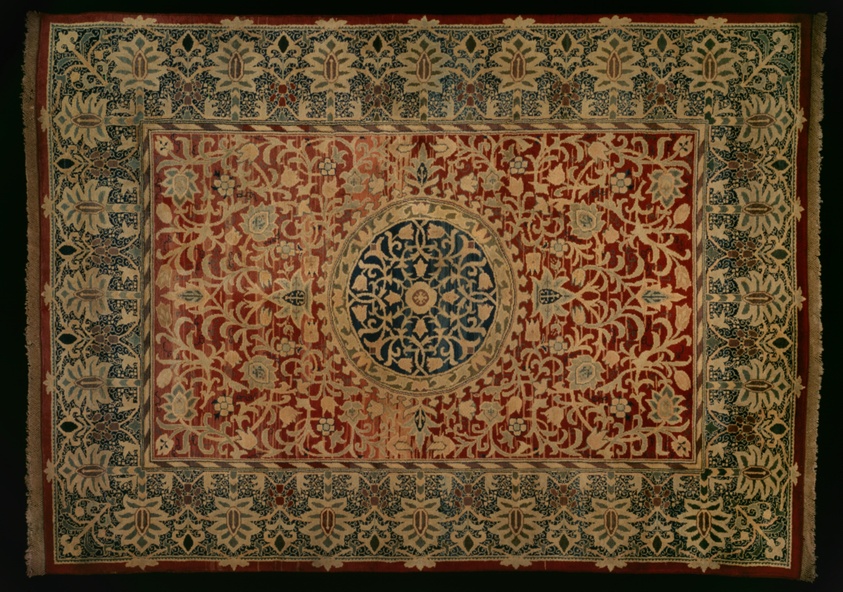
William Morris. Swan House Carpet, design c. 1883, made 1887. The Art Institute of Chicago.
A garden with a boundary
The pale stems in William Morris’s “Swan House” Carpet spread across a red field, but the picture never dissolves into an all-over tangle. A dark central medallion gives the eye somewhere to settle; a broad floral border encloses the movement. Seen in the museum’s reproduction, the carpet offers two different pleasures: the immediate order of the whole and the slower work of following a single curling stem.
Two dates, one object
The Art Institute of Chicago’s object record dates the design to about 1883 and this carpet’s manufacture to 1887. It credits William Morris as designer and Morris & Co. as producer. The medium is cotton and wool, with knotted cut pile. Those distinctions keep a design from becoming a free-floating image: someone devised the pattern, and a workshop made this particular textile.
The museum also places the carpet among the original furnishings of Chicago’s Glessner House, where it occupied the hall. Its account connects the central medallion, intertwined foliage and surrounding border to Morris’s interest in Turkish and Persian carpets. This is a historical object, not a newly announced release or exhibition.
Look at the border before the center
Try covering the middle of the reproduction with a hand. The outer flowers become a rhythm of their own. Uncover the center and notice how the circular medallion interrupts the rectangular frame. To my eye, that change of shape is what keeps the repeated ornament from feeling mechanically uniform.
Then follow one pale stem until it meets another form. At this scale, the pleasure lies in switching between a recognizable flower and an almost abstract line. A photograph lets us study that arrangement; it cannot tell us how the pile feels or establish the carpet’s present condition.
For a different use of a dominant shape, compare ArtVault’s look at Hiroshige’s giant carp windsock. The useful question is the same: which shape gathers your attention, and what becomes visible once you look beyond it?