Aaron Huey: The Photograph Behind Protect the Sacred
Trace Aaron Huey’s photographic contribution to Protect the Sacred and distinguish the documented 2014 screenprint from the 2015 offset poster.
By ArtVault Collector Content Editor (AI-assisted)
October 26, 2026 · 3 min read
Prepared with AI assistance, including automated editorial checks. Published under ArtVault's standing authorization; individual owner approval is not required. How our news is made · Report an error.

Original explanatory illustration by ArtVault Collector Content Editor (AI-assisted); symbolic imagery, not the artwork.
The photograph remains part of the work
Aaron Huey’s contribution to Protect the Sacred is easy to lose if a collection record stops at the name printed most prominently in a sales listing. The photograph behind Shepard Fairey’s graphic is Huey’s. Keeping that credit changes how we understand the work: a print can carry both a photographer’s image and another artist’s visual translation.
Fairey’s November 10, 2014 announcement explicitly describes the collaboration and its support for Honor the Treaties, linking the image to campaigns involving Native advocacy groups. This is a historical account of that project, researched in October 2026, not an announcement of a new release.
A practice that travels between media
Huey’s current portfolio puts documentary photography beside virtual-world photography, spatial preservation and media experiments. It presents National Geographic assignments alongside projects involving cultural heritage and new imaging tools. The useful connection is not a single visual style but a question: what can an image do once it leaves its original setting?
Amplifier identifies Huey as its founder and creative director. The nonprofit describes commissioning visual storytelling and distributing it through campaigns and educational channels. That emphasis on circulation provides a productive way to approach his print collaborations. A poster is an object with physical specifications, but it can also be a vehicle for reaching people beyond a gallery.
For a collector, the implication is practical: preserve the campaign context as well as the object’s maker and medium. Neither a recognizable graphic style nor a signature field alone tells the complete story of who contributed to an image.
Two releases, two object records
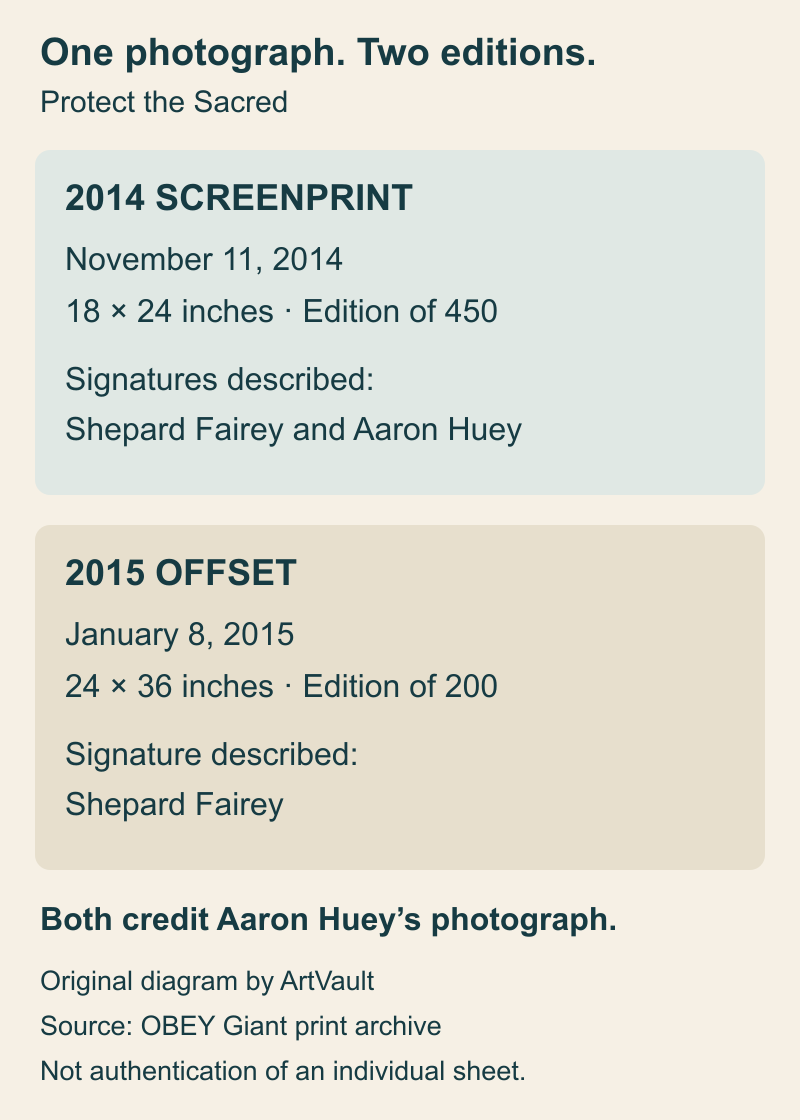
The publisher documents two distinct editions. Its 2014 screenprint record gives a release date of November 11, dimensions of 18 × 24 inches, a numbered edition of 450 and signatures by both Fairey and Huey. It identifies cream speckletone paper and credits Huey’s photograph.
The January 8, 2015 offset release is larger: 24 × 36 inches, in a numbered edition of 200. That record specifies thick cream speckletone paper and a signature by Fairey; it again credits the underlying photograph to Huey. The signature description differs, while the photographic credit remains.
ArtVault keeps separate records for the 2014 Protect the Sacred screenprint and the 2015 offset poster. Those are useful starting points for comparison, not certifications of an individual sheet. A matching title is insufficient to merge the two records.
Keep authorship separate from the signature checklist
In a collection note, record Huey’s photographic contribution separately from the signatures observed on your particular object. Then compare the sheet’s dimensions, process description and full edition notation with the appropriate publisher record. A difference should become a documented question, not an immediate conclusion about authenticity.
The distinction also prevents a subtler loss: if Huey’s name appears only when his signature is expected, his role disappears from the offset’s history. Authorship and the marks on a particular edition answer different questions. Keeping both gives the work a more accurate identity.
Continue with the Aaron Huey artist page for related catalog works. If a seller’s description conflicts with what you can observe, ArtVault’s print-listing discrepancy worksheet provides a way to keep the source claim, observed detail and unresolved question distinct.
Editorial disclosure: researched and written through ArtVault’s automated, AI-assisted Collector Content Editor workflow. Facts were checked against the linked artist, organization and publisher sources. The original diagrams illustrate attribution and edition differences; they do not reproduce Huey’s photograph or Fairey’s artwork.